
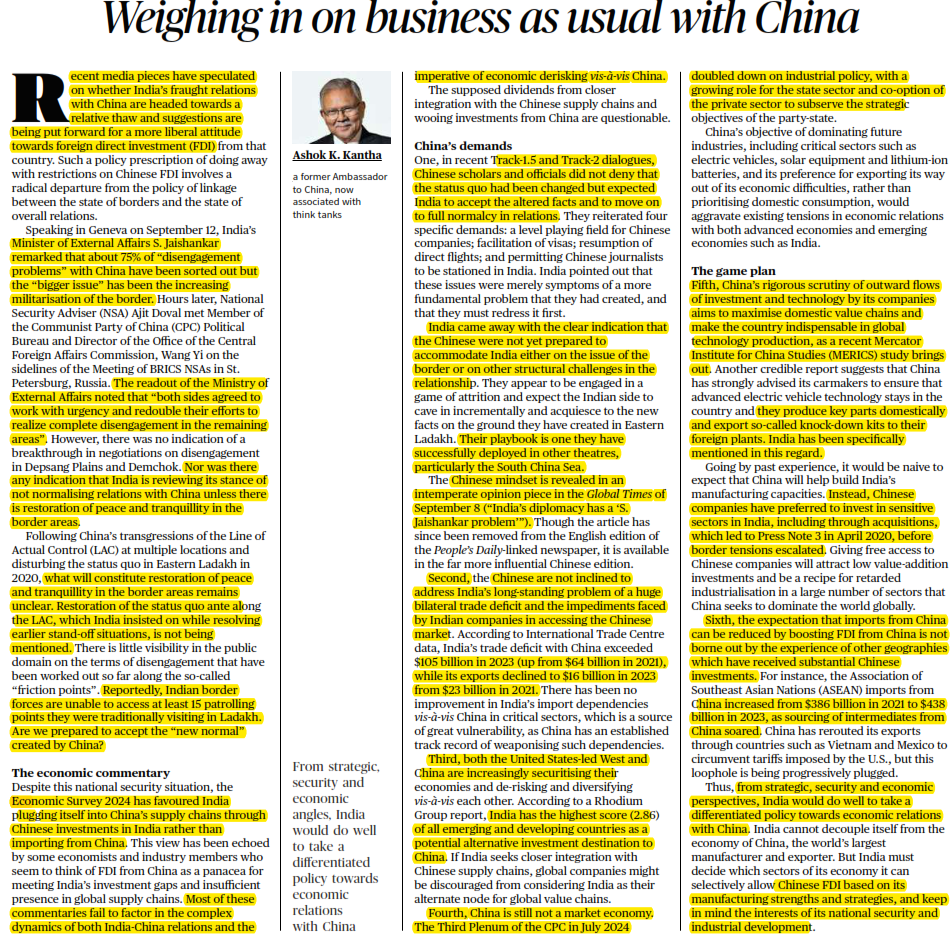
Weighing in on business as usual with China
- In recent discussions surrounding India-China relations, a crucial question has emerged: Should India reconsider its approach to Chinese Foreign Direct Investment (FDI)? This debate, which reflects deeper strategic, economic, and security concerns, has intensified amidst the backdrop of unresolved border tensions, especially since the 2020 Eastern Ladakh standoff.
- As China continues its aggressive military posturing along the Line of Actual Control (LAC), India faces a multifaceted challenge — balancing national security imperatives with economic aspirations.
Key Points of Contention
The Border Issue and Normalisation of Relations:
- Despite some progress in disengagement talks, as acknowledged by India’s Minister of External Affairs S. Jaishankar and National Security Adviser Ajit Doval, the border situation remains far from resolved. India’s insistence on the restoration of peace and tranquillity in border areas as a precondition for normalising relations has not changed.
- China’s reluctance to restore the status quo ante along the LAC suggests a broader strategy of attrition. By altering facts on the ground, China appears to be testing India’s resolve, much like its approach in the South China Sea.
- Accepting the new realities in Eastern Ladakh could set a dangerous precedent, potentially eroding India’s strategic autonomy.
Economic Dependence and FDI Concerns:
- While the Economic Survey 2024 advocates greater integration with Chinese supply chains and suggests that Chinese FDI could help bridge India’s investment gaps, this view underestimates the risks involved.
- Chinese scholars have made it clear that India should accept the new border realities and normalise relations, which includes reopening avenues for Chinese investments, easing visa restrictions, and resuming direct flights.
- India's growing trade deficit with China, which ballooned to over $105 billion in 2023, remains a point of contention. Furthermore, Indian companies face significant barriers when accessing the Chinese market, while China continues to weaponize economic dependencies in critical sectors.
Global Trends in Economic Decoupling:
- As the United States and other Western nations intensify their efforts to decouple from China, India finds itself in a precarious position. The global trend towards de-risking from China, which involves diversifying supply chains and reducing dependence on Chinese investments, underscores the complexities of India’s economic ties with its northern neighbor.
- A report by the Rhodium Group positions India as a promising alternative investment destination, making closer integration with Chinese supply chains potentially counterproductive. Foreign firms might hesitate to view India as a viable node in global value chains if it becomes too enmeshed in China’s economic orbit.
China’s Industrial Policy and FDI Strategy:
- China’s state-controlled economic policies, especially its emphasis on dominating future industries like electric vehicles and solar equipment, raise concerns about the nature of Chinese FDI in India.
- Past experiences suggest that Chinese investments are often concentrated in sensitive sectors, which could hinder rather than help India’s industrial development.
- A MERICS report highlights China’s reluctance to transfer advanced technology to foreign markets, preferring instead to safeguard its intellectual property and focus on exporting lower-value knock-down kits.
- In this scenario, it is unlikely that Chinese FDI would significantly contribute to India’s long-term industrial growth.
Strategic Considerations for India
Selective Engagement:
- India cannot fully decouple from China, given China’s status as the world’s largest manufacturer and exporter. However, India can adopt a selective approach by allowing Chinese FDI in sectors where it holds strategic advantages and can control outcomes.
- For instance, restricting Chinese involvement in sensitive sectors like telecommunications, defense, and critical infrastructure is imperative to safeguarding national security.
Focus on Building Domestic Capacities:
- To reduce reliance on Chinese imports, India must focus on strengthening its own manufacturing sector and enhancing its global supply chain integration with non-Chinese partners.
- Pumped hydro and battery storage systems are examples of areas where India can expand its capabilities while reducing dependency on Chinese technology.
Maintaining a Strategic Balance:
- While economic engagement with China cannot be entirely avoided, it must be carefully balanced with India's broader national security and strategic interests. Accepting Chinese FDI in certain sectors might bring short-term benefits, but it should not come at the cost of long-term economic vulnerability.
Conclusion:
- India’s policy towards Chinese FDI requires a nuanced and strategic approach. While there are undeniable economic incentives to tapping into Chinese investments, the risks posed by border tensions, economic dependencies, and global geopolitical trends cannot be ignored.
- India’s future decisions must reflect a balance between economic pragmatism and the imperative to secure its strategic autonomy, ensuring that the country remains resilient against both economic and security challenges posed by China.