
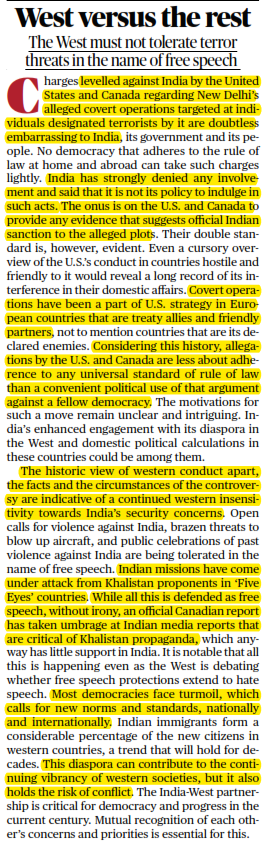
West versus the rest
- The passage discusses the recent allegations made by the United States and Canada against India regarding its supposed covert operations targeting individuals deemed terrorists by these countries. It emphasizes the complexity and sensitivity of these charges, particularly in the context of international relations and domestic politics. Here are the key themes and insights:
Key Themes:
Denial of Allegations:
- India has firmly denied the accusations, asserting that it does not engage in covert operations against individuals as described by the U.S. and Canada.
- The passage emphasizes that no democracy should take such charges lightly, particularly those that could undermine the rule of law.
Burden of Proof:
- The responsibility lies with the U.S. and Canada to provide credible evidence that supports their claims regarding India's alleged covert actions.
- The passage suggests a need for transparency and accountability in international accusations.
Double Standards:
- The author points out what they perceive as a double standard in how the U.S. and Canada handle covert operations, highlighting a historical pattern of U.S. interference in other nations' affairs, both friendly and hostile.
- This raises questions about the motivations behind the allegations against India, implying that they may be politically motivated rather than grounded in a universal standard of law.
Western Insensitivity to India's Security Concerns:
- The passage outlines India's security issues, including threats from Khalistan supporters and acts of violence against its interests abroad.
- It argues that while Western nations defend certain speech acts as free expression, they simultaneously react negatively to critiques of those same ideologies that threaten India's stability.
Impact of the Indian Diaspora:
- The Indian diaspora in Western countries is noted for its significant size and potential influence on local societies.
- However, the author warns that this demographic could also lead to conflicts if not handled with mutual respect and understanding.
Importance of India-West Relations:
- The relationship between India and Western democracies is framed as critical for promoting democracy and progress in the 21st century.
- Acknowledging and addressing each other's security concerns and political priorities is presented as vital for a successful partnership.
Conclusion:
- The passage highlights the intricate dynamics of international relations, especially regarding allegations of misconduct between democracies. It underscores the need for mutual respect, understanding of security concerns, and the complexities arising from a diverse diaspora.
- By calling attention to perceived double standards and historical conduct, the author advocates for a more nuanced and cooperative approach to India-West relations that prioritizes shared democratic values and security.