
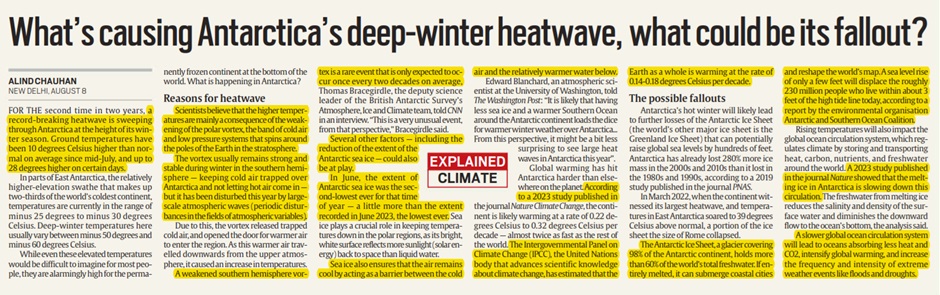
What’s causing Antarctica’s deep-winter heatwave, what could be its fallout?
- For the second time in two years, a record-breaking heatwave is sweeping through Antarctica at the height of its winter season.
- Global warming has hit Antarctica harder than elsewhere on the planet.
- According to a 2023 study published in the journal Nature Climate Change, the continent is likely warming at a rate of 0.22 degrees Celsius to 0.32 degrees Celsius per decade almost twice as fast as the rest of the world.
- The Intergovernmental Panel on Climate Change (IPCC), the United Nations body that advances scientific knowledge about climate change, has estimated that the Earth as a whole is warming at the rate of 0.14-0.18 degrees Celsius per decade.
Reasons for heatwave
- Scientists believe that the higher temperatures are mainly a consequence of the weakening of the polar vortex
- Polar vortex is a band of cold air and low pressure systems that spins around the poles of the Earth in the stratosphere.
- The vortex usually remains strong and stable during winter in the southern hemisphere keeping cold air trapped over Antarctica and not letting hot air come in but it has been disturbed this year by large-scale atmospheric waves.
- Due to this, the vortex released trapped cold air, and opened the door for warmer air to enter the region.
- As this warmer air travelled downwards from the upper atmosphere, it caused an increase in temperatures.
- A weakened southern hemisphere vortex is a rare event that is only expected to occur once every two decades on average
- Several other factors including the reduction of the extent of the Antarctic sea ice could also be at play.
- In June, the extent of Antarctic sea ice was the second-lowest ever for that time of year, a little more than the extent recorded in June 2023, the lowest ever.
- Sea ice plays a crucial role in keeping temperatures down in the polar regions, as its bright, white surface reflects more sunlight (solar energy) back to space than liquid water.
The possible effects
- Antarctica’s hot winter will likely lead to further losses of the Antarctic Ice Sheet (the world’s other major ice sheet is the Greenland Ice Sheet) that can potentially raise global sea levels by hundreds of feet.
- Antarctica has already lost 280% more ice mass in the 2000s and 2010s than it lost in the 1980s and 1990s, according to a 2019 study published in the journal PNAS.
- In March 2022, when the continent witnessed its largest heatwave, and temperatures in East Antarctica soared to 39 degrees Celsius above normal, a portion of the ice sheet the size of Rome collapsed.
- The Antarctic Ice Sheet, a glacier covering 98% of the Antarctic continent, holds more than 60% of the world’s total freshwater.
- If entirely melted, it can submerge coastal cities and reshape the world’s map.
- Rising temperatures will also impact the global ocean circulation system, which regulates climate by storing and transporting heat, carbon, nutrients, and freshwater around the world.
- The freshwater from melting ice reduces the salinity and density of the surface water and diminishes the downward flow to the ocean’s bottom.
- A slower global ocean circulation system will lead to oceans absorbing less heat and CO2, intensify global warming, and increase the frequency and intensity of extreme weather events like floods and droughts.