
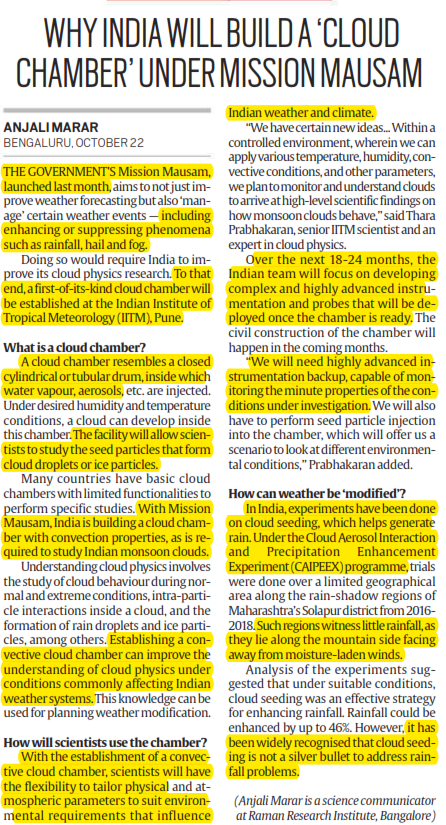
WHY INDIA WILL BUILD A 'CLOUD CHAMBER' UNDER MISSION MAUSAM
- Mission Mausam, launched by the government last month, aims to not just improve weather forecasting in the country but also ‘manage’ certain weather events, and on demand, enhance or suppress rainfall, hail, fog and, later, lightning strikes.
Highlights:
- Mission Mausam, recently launched by the Indian government, aims to improve weather forecasting and develop the capability to manage weather events, such as enhancing or suppressing rainfall, hail, fog, and potentially lightning strikes. To support these goals, India is setting up a cloud chamber at the Indian Institute of Tropical Meteorology (IITM), Pune, to advance research in cloud physics, a key area for weather modification.
What is a Cloud Chamber?
- A cloud chamber is a cylindrical or tubular enclosed space where water vapour and aerosols are injected under controlled humidity and temperature to allow the formation of clouds. The Pune facility will be unique as it will be India's first chamber with convective properties, designed to study clouds typical of the Indian monsoon.
Purpose of the Convective Cloud Chamber:
- The cloud chamber will allow scientists to simulate cloud formation and study:
- The seed particles that form cloud droplets or ice particles.
- Cloud behaviour during normal and extreme weather conditions.
- Interactions within and between cloud layers.
- Formation of rain droplets and ice particles.
- How cyclones or low-pressure systems influence cloud dynamics.
- By understanding these factors, scientists can better plan and implement weather modification strategies.
Strategic Use of the Chamber:
- The chamber will enable researchers to customize various physical and atmospheric parameters such as temperature, humidity, and convective conditions to mirror Indian weather systems. According to Thara Prabhakaran, a senior scientist at IITM, this setup will help them monitor and study monsoon cloud behaviour, leading to advanced scientific findings.
- The next 18-24 months will focus on developing advanced instrumentation and probes to monitor minute environmental changes in the chamber. Civil construction of the chamber will commence soon, and scientists will then conduct seed particle injections to simulate different weather conditions.
India's Cloud Seeding Experience:
- India has previously experimented with cloud seeding through the Cloud Aerosol Interaction and Precipitation Enhancement Experiment (CAIPEEX) program, conducted over four phases in the past decade.
- One major experiment, conducted from 2016 to 2018 in Maharashtra's Solapur district, showed that rainfall could be increased by up to 46% in certain areas, and 18% on average over a 100 sq km area.
- However, cloud seeding has limitations and is not seen as a silver bullet for resolving rainfall deficits, but rather as a complementary tool under specific conditions.
Prelims Takeaways:
- Mission Mausam
- Cloud Aerosol Interaction and Precipitation Enhancement Experiment (CAIPEEX) programme