
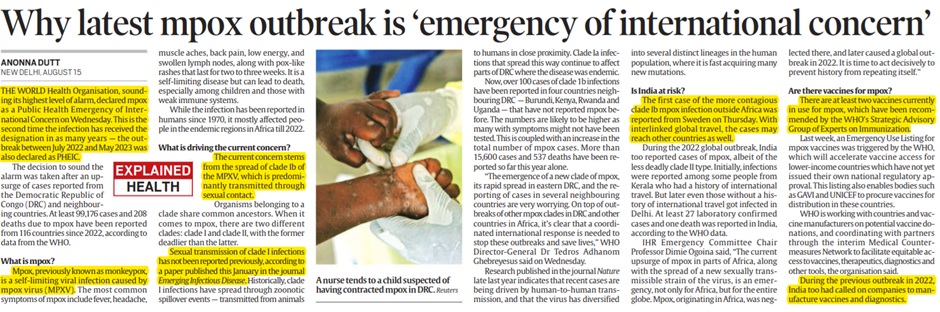
Why latest mpox outbreak is ‘emergency of international concern’
- Mpox, previously known as monkeypox, has re-emerged as a significant global health threat, prompting the World Health Organization (WHO) to declare it a Public Health Emergency of International Concern (PHEIC).
- This declaration underscores the severity of the ongoing outbreak and the potential for it to spread further.
What is Mpox?
- Mpox is a viral infection caused by the mpox virus (MPXV).
- The disease is characterized by symptoms such as fever, headache, muscle aches, back pain, low energy, swollen lymph nodes, and pox-like rashes.
- While typically self-limiting, the infection can be fatal, especially among children and immunocompromised individuals.
- Mpox has been reported in humans since 1970, primarily affecting regions in Africa where the virus was endemic.
- The global outbreak between July 2022 and May 2023 marked a significant shift, with the disease spreading beyond its usual geographic confines.
New Clade and Transmission
- The current alarm has been raised due to the emergence of clade Ib of the mpox virus, which is being predominantly transmitted through sexual contact.
- This is a departure from the traditional zoonotic transmission of the virus (from animals to humans).
- ver 100 cases of clade Ib have been reported in countries neighboring the Democratic Republic of Congo (DRC), including Burundi, Kenya, Rwanda, and Uganda.
- These countries had not reported mpox cases prior to this outbreak.
Global and National Response
- The WHO’s Strategic Advisory Group of Experts on Immunization has recommended at least two vaccines for mpox.
- An Emergency Use Listing for these vaccines was recently triggered, facilitating faster access for lower-income countries.
- The WHO's listing allows organizations like GAVI and UNICEF to procure and distribute vaccines to countries that have not yet approved them at the national level.
Implications for India
- India is at risk of mpox spread, particularly given the global interconnectedness through travel.
- During the 2022 outbreak, India reported 27 laboratory-confirmed cases and one death, primarily linked to international travel.
- However, there were also cases in Delhi with no travel history, indicating local transmission.
Preventive Measures
- Given the potential for the more contagious clade Ib to reach India, it is essential to strengthen surveillance, ensure public awareness, and prepare for possible vaccine distribution.
- The spread of a new, more transmissible strain of the mpox virus, particularly in Africa, highlights the need for a coordinated international response.
- The WHO Director-General has emphasized the urgency of addressing the crisis to prevent a repeat of the 2022 global outbreak.
- The current situation presents an opportunity for global health bodies to improve preparedness and response mechanisms for infectious diseases, especially those originating in regions with limited healthcare infrastructure.