
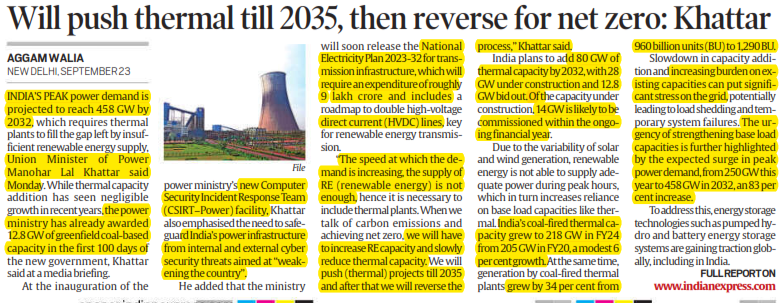
Will push thermal till 2035, then reverse for net zero: Khattar
- India’s peak power demand is projected to reach 458 GW by 2032, which requires thermal plants to fill the gap left by insufficient renewable energy supply,
Highlights:
- India's peak power demand is projected to surge to 458 GW by 2032, an 83% increase from the current demand of 250 GW. While renewable energy (RE) sources are being aggressively promoted to meet the country's growing energy needs, Union Minister of Power Manohar Lal Khattar has emphasized the critical role of thermal power in bridging the supply gap during this period.
- Khattar noted that despite the variability in solar and wind power generation, thermal plants remain essential to provide stable base-load capacity, especially during peak demand hours.
Key Insights:
Thermal Power Capacity and Growth:
- In recent years, growth in thermal capacity has been slow, but the Ministry of Power has approved 12.8 GW of coal-based capacity within the first 100 days of the new government, indicating a renewed focus on thermal energy.
- By 2032, 80 GW of thermal capacity is planned, with 28 GW currently under construction and 14 GW expected to be commissioned this fiscal year. This is in response to the expected peak power demand of 458 GW by 2032, as renewable energy alone cannot yet fully meet peak demand.
Challenges with Renewable Energy Supply:
- Due to the intermittent nature of solar and wind energy, renewable sources struggle to provide consistent power during high-demand periods.
- Although India has made significant strides in expanding its renewable capacity, variability continues to present challenges for peak-hour supply.
- This has increased the reliance on coal-fired thermal plants, which saw 34% growth in generation from 960 billion units (BU) in FY20 to 1,290 BU in FY24.
- India’s coal-fired capacity increased modestly from 205 GW in FY20 to 218 GW in FY24, a growth of just 6%. The increasing burden on these plants could lead to grid stress, load shedding, and system failures if not addressed.
Energy Storage and Future Solutions:
- To mitigate the challenges posed by the variability of renewable energy, energy storage technologies are gaining attention globally. India has identified 184 GW of potential in pumped hydro storage, with 4.7 GW currently installed, 6.47 GW under construction, and 60 GW under survey and investigation.
- Energy storage systems, like pumped hydro and battery storage, are seen as critical tools to ensure grid stability as renewable energy penetration grows.
National Electricity Plan 2023-32:
- Khattar announced that the upcoming National Electricity Plan (NEP) 2023-32 will focus on expanding India’s transmission infrastructure. By 2032, the transmission network will grow from 4.85 circuit kilometers (ckm) to 6.48 ckm, and transformer capacity will increase from 1,251 gigavolt-amperes (GVA) to 2,342 GVA.
- This infrastructure expansion is crucial for the efficient integration of renewable energy and ensuring stable power delivery.
- The NEP also includes plans to double the capacity of high-voltage direct current (HVDC) lines to 33.25 GW, which are vital for transmitting renewable energy across long distances.
Cybersecurity Threats to Power Infrastructure:
- At the inauguration of the power ministry’s new Computer Security Incident Response Team (CSIRT-Power) facility, concerns were raised about the vulnerability of India's power infrastructure to internal and external cyber threats.
- The digital transformation of the power sector has exposed it to attacks from state-sponsored adversaries. All power utilities have appointed Chief Information Security Officers (CISOs) and are conducting cybersecurity audits to safeguard critical infrastructure.
Prelims Takeaways:
- CSIRT–Power
- National Electricity Plan (NEP)