
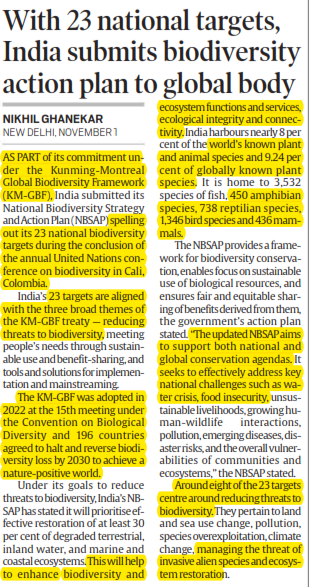
With 23 national targets, India submits biodiversity action plan to global body
- India’s 23 targets are aligned with the three broad themes of the KM-GBF treaty – reducing threats to biodiversity, meeting people’s needs through sustainable use and benefit-sharing, and tools and solutions for implementation and mainstreaming.
Highlights:
Overview of NBSAP Submission:
- In line with the Kunming-Montreal Global Biodiversity Framework (KM-GBF), India submitted its updated National Biodiversity Strategy and Action Plan (NBSAP) during the United Nations biodiversity conference in Cali, Colombia.
- This plan outlines 23 national biodiversity targets aimed at addressing key biodiversity challenges and aligning with KM-GBF's three main objectives:
- Reducing threats to biodiversity
- Meeting human needs through sustainable use and benefit-sharing
- Tools for implementation and mainstreaming
- The KM-GBF, adopted in 2022, seeks to halt and reverse biodiversity loss globally by 2030, with 196 countries, including India, committing to this goal.
Targets for Reducing Biodiversity Threats:
- India’s NBSAP prioritizes the restoration of at least 30% of degraded ecosystems across terrestrial, inland water, marine, and coastal environments. These efforts are expected to strengthen biodiversity, ecosystem services, and connectivity.
- India is home to around 8% of the world’s plant and animal species and has a significant diversity of fish, amphibians, reptiles, birds, and mammals.
- Eight key targets are dedicated to addressing biodiversity threats, focusing on:
- Land and sea use changes
- Pollution control
- Species overexploitation
- Climate change impacts
- Invasive alien species management
- Ecosystem restoration
- Managing Invasive Alien Species
- One priority is to tackle invasive alien species by minimizing their introduction and impact on native ecosystems. This involves:
- Managing pathways that introduce these species
- Eradicating or controlling invasive species at priority sites, including islands
- Introducing quarantine measures to monitor species introduction and developing a national database for tracking and managing invasive species
- Pathways for invasive species include the trade of exotic wildlife, abandoned exotic pets, and farming of exotic fish for commercial purposes.
Financial Support and Expenditure Estimates:
- India’s biodiversity targets require substantial financial investment. According to national biodiversity expenditure reviews, India’s annual average biodiversity expenditure from 2017-18 to 2021-22 was approximately Rs 32,207.13 crore.
- To meet targets from 2024-25 to 2029-30, the projected annual expenditure will need to increase to Rs 81,664.88 crore. The NBSAP emphasizes the need for a more comprehensive financial assessment to meet these ambitious goals effectively.
- India’s NBSAP provides a structured roadmap to advance both national and global biodiversity conservation, tackling pressing issues like water crisis, food insecurity, pollution, and human-wildlife conflict. By addressing these challenges, India aims to foster a more sustainable and resilient ecosystem.
Prelims Takeaways
- Kunming-Montreal Global Biodiversity Framework (KM-GBF)
- National Biodiversity Strategy and Action Plan (NBSAP)