
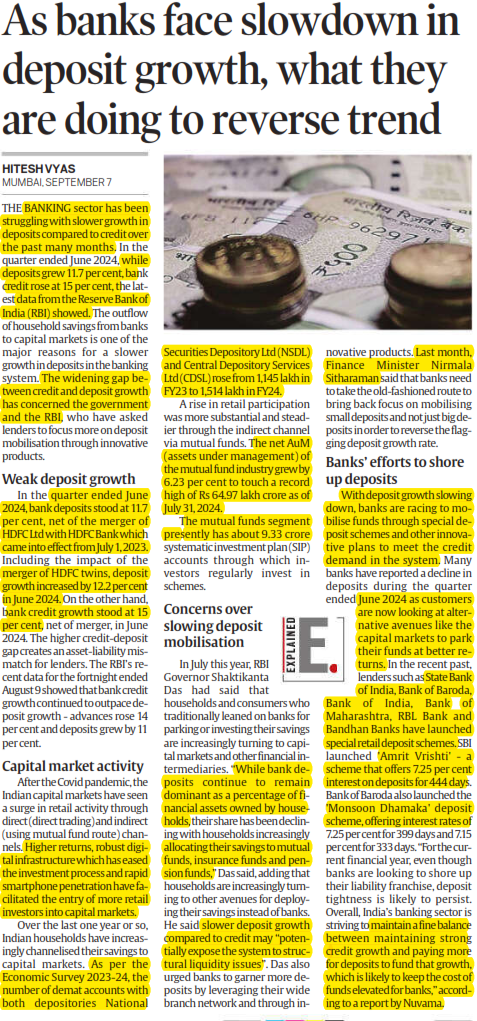
As bank face slowdown in deposit growth, what they are doing to reverse trend
- The widening gap between credit and deposit growth has concerned the government and the RBI, who have asked lenders to focus more on deposit mobilisation through innovative products.
Highlights:
- The Indian banking sector is grappling with a growing divergence between deposit and credit growth, leading to concerns of an asset-liability mismatch.
- As of June 2024, data from the Reserve Bank of India (RBI) shows that while bank deposits grew by 11.7%, bank credit surged by 15%.
- This gap indicates that banks are lending at a faster pace than they are accumulating deposits, raising alarms for both the RBI and the government.
Why the Gap Exists: Capital Market Influence:
- One of the primary reasons for the slower deposit growth is the shift in household savings from traditional bank deposits to capital markets.
- After the COVID-19 pandemic, Indian retail investors have flocked to stock markets and mutual funds, drawn by higher returns and the ease of investing through digital platforms and smartphone penetration.
- According to the Economic Survey 2023-24, the number of demat accounts has increased from 11.45 crore in FY23 to 15.14 crore in FY24, and mutual funds have seen their assets under management (AUM) grow to a record ₹64.97 lakh crore.
- With 9.33 crore systematic investment plan (SIP) accounts in operation, more households are choosing these avenues over bank deposits, impacting banks' ability to grow their deposit base.
Structural Liquidity Risks:
- The RBI Governor, Shaktikanta Das, highlighted the risks posed by slower deposit growth, stating that this trend could lead to structural liquidity issues. Banks traditionally rely on deposits to fund loans, and with fewer deposits coming in, the risk of liquidity shortfalls rises.
- This is particularly concerning when credit growth outpaces deposit growth, as seen in the August 9 data, where credit grew by 14% while deposits only rose by 11%.
Government and RBI's Response:
- Both the government and the RBI have called on banks to focus on deposit mobilisation. Finance Minister Nirmala Sitharaman emphasized the need to attract smaller deposits, not just large ones, while Shaktikanta Das urged banks to leverage their extensive branch networks and develop innovative deposit schemes.
- This push is aimed at reversing the trend of declining deposit growth and ensuring banks have enough liquidity to meet rising credit demands.
Banks’ Response: Innovative Deposit Schemes:
- In response to the growing concern, banks have begun offering special deposit schemes with competitive interest rates to attract savers. For instance:
- State Bank of India (SBI) launched the ‘Amrit Vrishti’ scheme, offering 7.25% interest on deposits for 444 days.
- Bank of Baroda introduced the ‘Monsoon Dhamaka’ scheme, with interest rates of 7.25% for 399 days and 7.15% for 333 days.
- These efforts show that banks are taking proactive steps to boost their deposit bases, but challenges remain. A report by Nuvama, a financial services company, suggests that deposit tightness will persist in the near term, keeping the cost of funds elevated for banks.
Prelims Takeaways:
- Bank of Baroda
- Economic Survey 2023-24
- State Bank of India (SBI)