
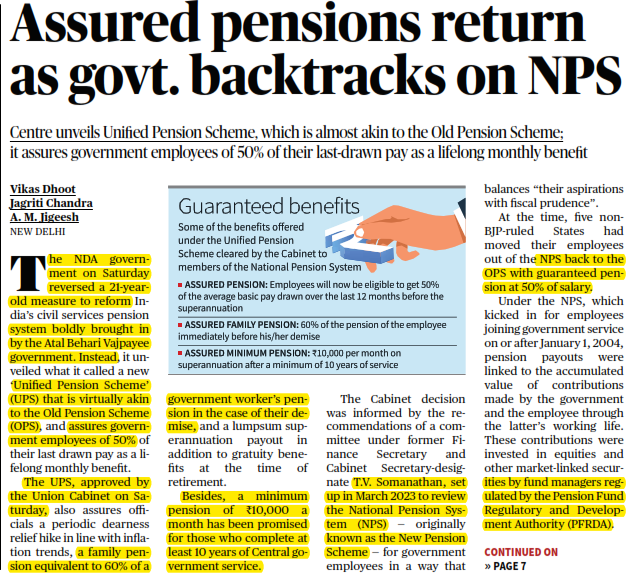
Assured pension return as govt. Backtracks on NPS
- Centre unveils Unified Pension Scheme, which is almost akin to the Old Pension Scheme; it assures government employees of 50% of their last-drawn pay as a lifelong monthly benefit
Highlights:
- In a significant policy shift, the NDA government, on August 24, 2024, reversed a 21-year-old reform of India’s civil services pension system that was originally introduced by the Atal Bihari Vajpayee administration.
- The newly unveiled Unified Pension Scheme (UPS), which resembles the Old Pension Scheme (OPS) in many ways, guarantees government employees 50% of their last drawn salary as a lifelong monthly pension.
Key Features of the Unified Pension Scheme:
- Guaranteed Pension: The scheme assures employees a pension amounting to 50% of their last drawn pay, echoing the OPS structure.
- Dearness Relief: In alignment with inflation trends, the UPS includes periodic dearness relief hikes to safeguard pensioners' purchasing power.
- Family Pension: In the event of the employee’s demise, the scheme provides a family pension equivalent to 60% of the employee’s pension.
- Superannuation and Gratuity: At the time of retirement, employees are entitled to a lumpsum superannuation payout in addition to gratuity benefits.
- Minimum Pension: The scheme guarantees a minimum pension of ₹10,000 per month for those who have completed at least 10 years of central government service.
- Contributory Structure: Unlike the OPS, the UPS is a contributory scheme. Employees will contribute 10% of their salary, while the government will contribute 18.5%. However, employee contributions will remain capped at 10%, with government contributions potentially adjustable based on periodic actuarial assessments.
Context and Rationale Behind the Reform:
- The introduction of the UPS follows the recommendations of a committee led by former Finance Secretary T.V. Somanathan, which was tasked with reviewing the National Pension System (NPS) for government employees.
- The aim was to balance employee aspirations with fiscal prudence. The NPS, implemented in 2004, linked pension payouts to contributions made by the government and the employee, with these funds invested in market-linked securities by fund managers regulated by the Pension Fund Regulatory and Development Authority (PFRDA).
- The shift towards the UPS comes at a time when several opposition-ruled states had already reverted to the OPS, which guaranteed pensions at 50% of salary, prompting a reevaluation of the NPS at the central level.
The Political and Employee Reactions:
- The UPS has garnered a mixed response from government employees and their representatives. While some groups, like the Central Secretariat Service Forum, appreciated the move towards an assured pension
- On the other hand, leaders like Shiv Gopal Mishra of the Joint Consultative Mechanism (JCM) welcomed the UPS and acknowledged Prime Minister Narendra Modi’s assurance of better coordination with employees.
- However, others, such as C. Srikumar of the All India Defence Employees Federation, remained dissatisfied, arguing that the UPS should have been a non-contributory scheme.
- The political implications of this reform are also noteworthy. Information and Broadcasting Minister Ashwini Vaishnaw highlighted that Congress-ruled states, which had announced a return to the OPS, have yet to implement it, whereas the NDA government has delivered a "well-consulted outcome" aimed at ensuring inter-generational equity.
Prelims Takeaways:
- OPS, NPS
- PFRDA