
Double health budget, reduce out-of-pocket spends
- A goal post that consistently shifts is the one related to raising public health spending to the magical figure of 2.5% of GDP.
- Currently, public health spending is about 1.35%. Low public spending implies high out- of-pocket expenditure by households.
- While 13.4% of households in rural areas and 8.5% in urban areas borrowed money to pay medical bills, the rest either sought access to free public care.
Below poverty line
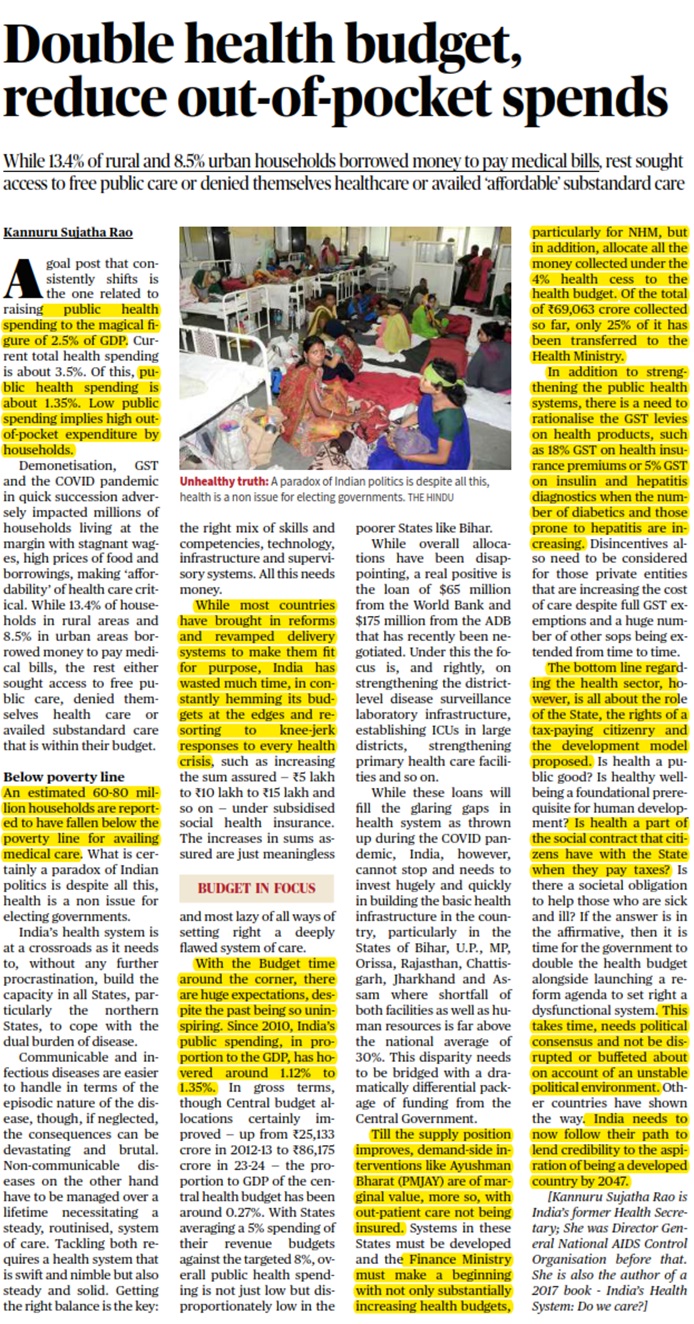
- An estimated 60-80 million households are reported to have fallen below the poverty line for availing medical care. What is certainly a paradox of Indian politics is despite all this, health is a non issue for electing governments.
- India’s health system is at a crossroads as it needs to, without any further procrastination, build the capacity in all States, particularly the northern States, to cope with the dual burden of disease.
- Communicable and infectious diseases are easier to handle in terms of the episodic nature of the disease, though, if neglected, the consequences can be devastating and brutal.
- Non-communicable diseases on the other hand have to be managed over a lifetime necessitating a steady, routinized, system of care.
- Tackling both requires a health system that is swift and nimble but also steady and solid.
- Getting the right balance is the key: the right mix of skills and competencies, technology, infrastructure and supervisory systems. All this needs money.
- Since 2010, India’s public spending, in proportion to the GDP, has hovered around 1.12% to 1.35%. In gross terms, though Central budget allocations certainly improved up from ₹25,133 crore in 2012-13 to ₹86,175 crore in 23-24 the proportion to GDP of the central health budget has been around 0.27%.
- With States averaging a 5% spending of their revenue budgets against the targeted 8%, overall public health spending is not just low but disproportionately low in the poorer States like Bihar.
- While overall allocations have been disappointing, a real positive is the loan of $65 million from the World Bank and $175 million from the ADB that has recently been negotiated. Under this the focus is, and rightly, on strengthening the district-level disease surveillance laboratory infrastructure, establishing ICUs in large districts, strengthening primary health care facilities and so on.
- India, needs to invest hugely and quickly in building the basic health infrastructure in the country, particularly in the States of Bihar, U.P., MP, Orissa, Rajasthan, Chattisgarh, Jharkhand and Assam
- Where the shortfall of both facilities as well as human resources is far above the national average of 30%.
- Till the supply position improves, demand-side interventions like Ayushman Bharat (PMJAY) are of marginal value, more so, with out-patient care not being insured.
- Systems in these States must be developed and the Finance Ministry must make a beginning with not only substantially increasing health budgets, particularly for NHM, but in addition, allocate all the money collected under the 4% health cess to the health budget.
- Of the total of ₹69,063 crore collected so far, only 25% of it has been transferred to the Health Ministry.
- In addition to strengthening the public health systems, there is a need to rationalise the GST levies on health products, such as 18% GST on health insurance premiums or 5% GST on insulin and hepatitis diagnostics when the number of diabetics and those prone to hepatitis are increasing.
- Disincentives also need to be considered for those private entities that are increasing the cost of care despite full GST exemptions and a huge number of other sops being extended from time to time.
- The bottom line regarding the health sector, however, is all about the role of the State, the rights of a tax-paying citizenry and the development model proposed.
- Is health a public good? Is healthy well-being a foundational prerequisite for human development? Is health a part of the social contract that citizens have with the State when they pay taxes? Is there a societal obligation to help those who are sick and ill? If the answer is in the affirmative, then it is time for the government to double the health budget alongside launching a reform agenda to set right a dysfunctional system.
- This takes time, needs political consensus and not be disrupted or buffeted about on account of an unstable political environment. Other countries have shown the way. India needs to now follow their path to lend credibility to the aspiration of being a developed country by 2047.