
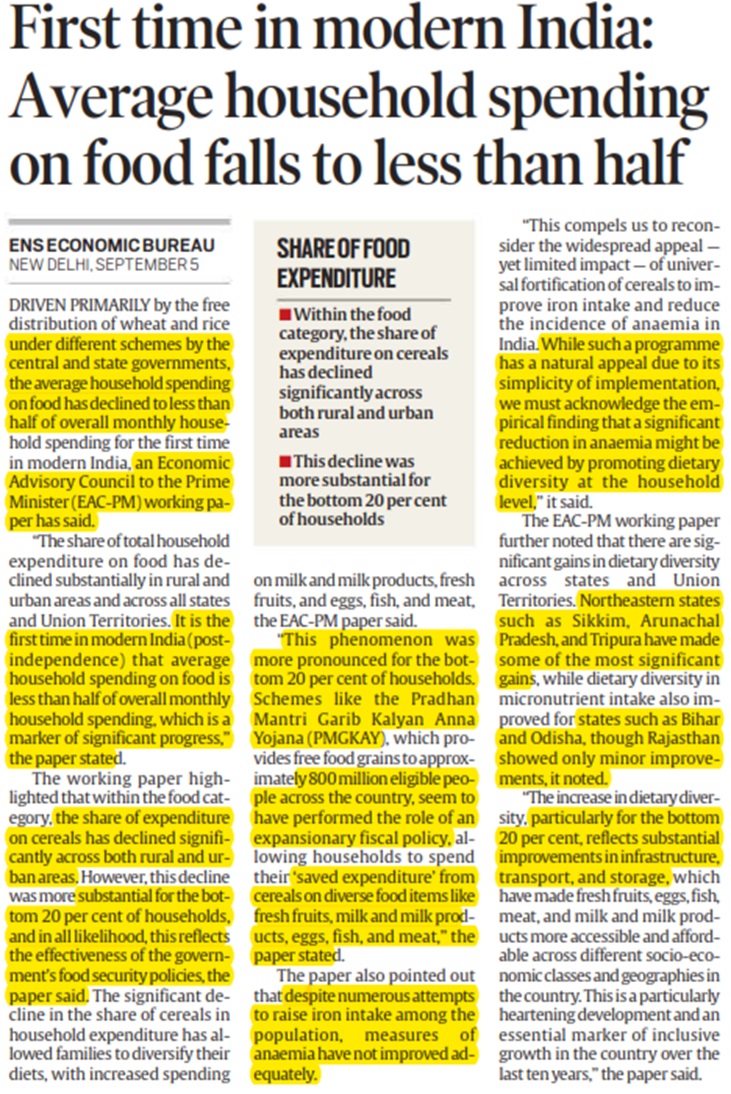
First time in modern India,Average household spending on food falls to less than half
- The working paper highlighted that within the food category, the share of expenditure on cereals has declined significantly across both rural and urban areas.
Highlights:
- A recent working paper by the Economic Advisory Council to the Prime Minister (EAC-PM) has revealed a significant shift in household spending patterns in India, driven largely by government food distribution schemes.
- For the first time since independence, the share of average household expenditure on food has fallen to less than half of the overall monthly household spending, marking a major milestone in India's economic development.
Key Findings:
Decline in Food Spending:
- The share of food in household expenditure has declined substantially in both rural and urban areas, as well as across all states and Union Territories.
- This reduction is attributed to the free distribution of wheat and rice under various central and state government schemes, which has eased the burden of cereal expenses for many households.
Impact of Food Security Policies:
- The paper highlights the effectiveness of the government’s food security programs, particularly the Pradhan Mantri Garib Kalyan Anna Yojana (PMGKAY).
- This scheme has provided free food grains to around 800 million eligible individuals, allowing families to save on cereal expenses.
- The saved income has enabled households, especially the bottom 20% of the population, to diversify their diets. There has been an increased expenditure on milk and milk products, fresh fruits, eggs, fish, and meat, reflecting an overall improvement in dietary quality.
Decline in Cereal Spending:
- The share of expenditure on cereals has seen a marked reduction, particularly among poorer households, indicating that they are benefiting the most from government food distribution programs. This shift has enabled them to spend more on nutritious and diverse food categories.
Anaemia and Dietary Diversity:
- Despite these positive developments, the paper points out that efforts to address anaemia have not yielded satisfactory results.
- It calls for a rethinking of the universal fortification of cereals, suggesting that improving dietary diversity at the household level might be more effective in reducing anaemia.
- The working paper underscores the need for targeted efforts to promote diverse and nutrient-rich diets, rather than relying solely on fortified cereals to tackle micronutrient deficiencies.
Infrastructure and Accessibility:
- The improvement in dietary diversity, particularly for the bottom 20%, is attributed to substantial gains in infrastructure, transport, and storage facilities, making fresh produce and protein-rich foods more accessible across socio-economic classes and geographies.
- States such as Sikkim, Arunachal Pradesh, and Tripura have made the most significant gains in dietary diversity, while Bihar and Odisha have also shown notable improvements.
Prelims Takeaways:
- PMGKAY