
ICMR and Panacea Biotec initiate the First Dengue Vaccine Phase 3 Clinical Trial in India with Indigenous Dengue Vaccine, DengiAll
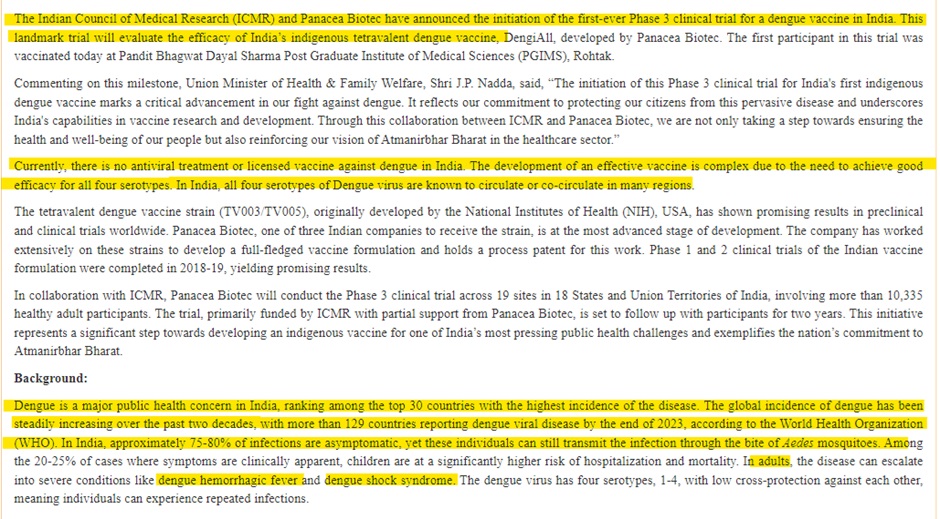
- Indian Council of Medical Research (ICMR) and Panacea Biotec have commenced the first-ever Phase 3 clinical trial for a dengue vaccine in the country.
Highlights:
- This trial marks a pivotal moment in India's public health landscape, reflecting the nation's progress in vaccine research and development, and reinforcing the vision of Atmanirbhar Bharat in the healthcare sector.
- The Phase 3 clinical trial will evaluate the efficacy of DengiAll, a tetravalent dengue vaccine developed by Panacea Biotec.
- This vaccine is the first indigenous attempt to address the dengue epidemic in India, a country that ranks among the top 30 nations with the highest incidence of the disease.
- Currently, India lacks both antiviral treatment and a licensed vaccine against dengue. The development of an effective dengue vaccine is particularly challenging due to the need to provide immunity across all four serotypes of the dengue virus, which are known to circulate or co-circulate in many regions of India.
- This complexity necessitates a vaccine that offers robust efficacy for each serotype.
- The tetravalent dengue vaccine strain (TV003/TV005) was initially developed by the National Institutes of Health (NIH) in the United States and has shown promising results in preclinical and clinical trials globally.
- Dengue is a major public health concern in India, with a significant portion of infections being asymptomatic yet capable of transmission through Aedes mosquito bites.
- Among the symptomatic cases, children are at a higher risk of hospitalization and mortality, while adults can suffer severe complications such as dengue hemorrhagic fever and dengue shock syndrome.
- The presence of four dengue virus serotypes, each offering limited cross-protection, means that individuals can experience repeated infections, further complicating disease management.
Prelims Takeaway
- Dengue