
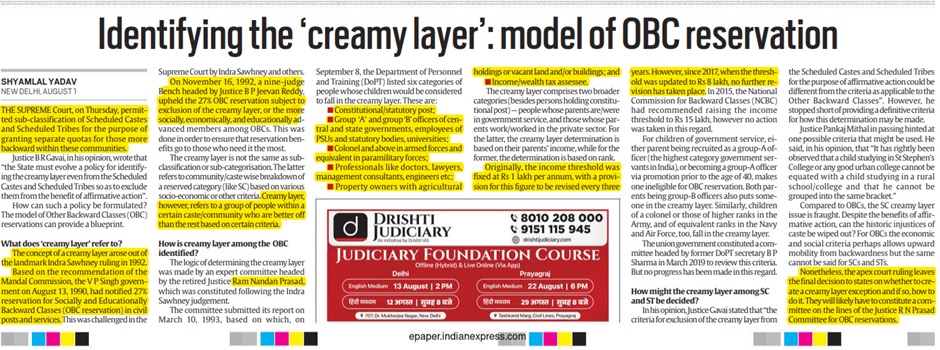
Identifying the ‘creamy layer’: model of OBC reservation
- The State must evolve a policy for identifying the creamy layer even from the Scheduled Castes and Scheduled Tribes so as to exclude them from the benefit of affirmative
Creamy layer
- The concept of a creamy layer arose out of the landmark Indra Sawhney ruling in 1992.
- Based on the recommendation of the Mandal Commission, the V P Singh government on August 13, 1990, had notified 27% reservation for Socially and Educationally Backward Classes (OBC reservation) in civil posts and services.
- This was challenged in the Supreme Court by Indra Sawhney and others.
- On November 16, 1992, a nine-judge Bench headed by Justice B P Jeevan Reddy, upheld the 27% OBC reservation subject to exclusion of the creamy layer, or the more socially, economically, and educationally advanced members among OBCs.
- This was done in order to ensure that reservation benefits go to those who need it the most.
- The creamy layer is not the same as sub-classification or sub-categorisation.
- The latter refers to community/caste wise breakdown of a reserved category (like SC) based on various socio-economic or other criteria.
- Creamy layer, however, refers to a group of people within a certain caste/community who are better off than the rest based on certain criteria.
How is creamy layer among the OBC identified
- The logic of determining the creamy layer was made by an expert committee headed by the retired Justice Ram Nandan Prasad, which was constituted following the Indra Sawhney judgment.
- The committee submitted its report listed six categories of people whose children would be considered to fall in the creamy layer.
- The creamy layer comprises two broader categories (besides persons holding constitutional post) people whose parents are/were in government service, and those whose parents work/worked in the private sector.
- For the latter, the creamy layer determination is based on their parents’ income, while for the former, the determination is based on rank.
- Originally, the income threshold was fixed at Rs 1 lakh per annum, with a provision for this figure to be revised every three years.
- However, since 2017, when the threshold was updated to Rs 8 lakh, no further revision has taken place.
- In 2015, the National Commission for Backward Classes (NCBC) had recommended raising the income threshold to Rs 15 lakh, however no action was taken in this regard.
- The union government constituted a committee headed by former DoPT secretary B P Sharma in March 2019 to review this criteria. But no progress has been made in this regard.
How might the creamy layer among SC and ST be decided?
- Justice Gavai stated that the criteria for exclusion of the creamy layer from the Scheduled Castes and Scheduled Tribes for the purpose of affirmative action could be different from the criteria as applicable to the Other Backward Classes.
- Compared to OBCs, the SC creamy layer issue is fraught.
- For OBCs the economic and social criteria perhaps allows upward mobility from backwardness but the same cannot be said for SCs and STs.
- Nonetheless, the apex court ruling leaves the final decision to states on whether to create a creamy layer exception and if so, how to do it.
- They will likely have to constitute a committee on the lines of the Justice R N Prasad Committee for OBC reservations.