
India’s fuel exports to Europe shift entirely to larger route around Africa amid attacks on ships in Red Sea
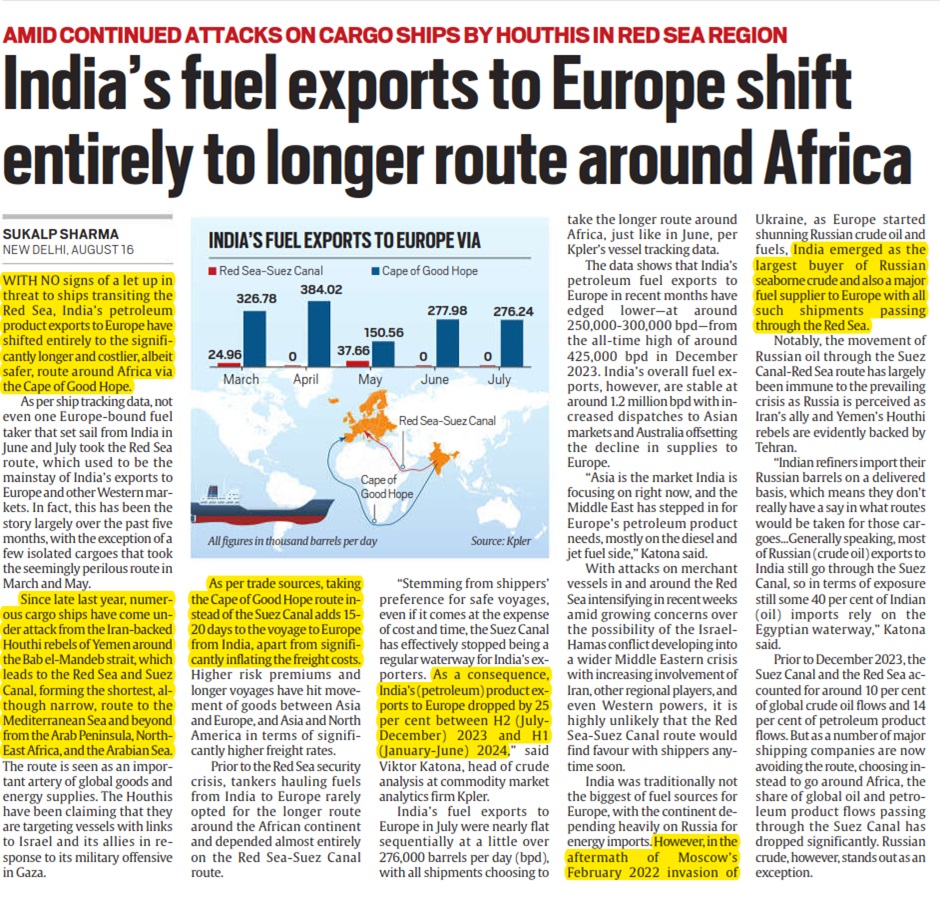
- India’s petroleum product exports to Europe have shifted entirely to the significantly longer and costlier, albeit safer, route around Africa via the Cape of Good Hope.
Highlights:
- This is due to no signs of a let up in threat to ships transiting the Red Sea
- In fact, this has been the story largely over the past five months, with the exception of a few isolated cargoes that took the seemingly perilous route in March and May.
- Since late last year, numerous cargo ships have come under attack from the Iran-backed Houthi rebels of Yemen
- The Houthis have been claiming that they are targeting vessels with links to Israel and its allies in response to its military offensive in Gaza.
- As per trade sources, taking the Cape of Good Hope route instead of the Suez Canal adds 15-20 days to the voyage to Europe from India, apart from significantly inflating the freight costs.
- Higher risk premiums and longer voyages have hit movement of goods between Asia and Europe, and Asia and North America in terms of significantly higher freight rates.
- Prior to the Red Sea security crisis, tankers hauling fuels from India to Europe rarely opted for the longer route around the African continent and depended almost entirely on the Red Sea-Suez Canal route.
- Stemming from shippers’ preference for safe voyages, even if it comes at the expense of cost and time, the Suez Canal has effectively stopped being a regular waterway for India’s exporters.
- As a consequence, India’s (petroleum) product exports to Europe dropped by 25 percent between H2 (July-December) 2023 and H1 (January-June) 2024.
Prelims Takeaway
- Map based question