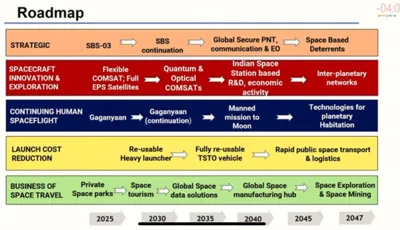
| Why in News? | V Narayanan, the newly appointed Chairman of ISRO, shared India's future space roadmap, including Gaganyaan, Chandrayaan-4, interplanetary missions, and space station development. |
| Key Missions | - Gaganyaan Mission (2026): India's first human spaceflight to 400 km Low Earth Orbit (LEO). - Chandrayaan-4 (2027): A 9,200 kg satellite targeting the Moon's south pole, with sample collection and experiments. |
| Advancements in Launch Vehicle Technology | ISRO's next-gen launch vehicle can carry 30,000 kg to LEO, marking a 1,000-fold increase in payload capacity from the SLV 3. The vehicle will feature reusability with first-stage recovery. |
| SpaDEX Mission | ISRO achieved satellite docking in LEO in January 2025, becoming the 4th country to do so. The success paves the way for a five-module space station scheduled for 2028. |
| India's Satellite Infrastructure | India has 131 satellites in orbit, with 56 actively serving national needs like telecommunication and border monitoring. ISRO collaborates with private companies for satellite development. |
| NavIC System | Phase II of the NavIC navigation satellite system will deploy five more satellites, enhancing India's global navigation capabilities. |
| Space Sustainability | ISRO is tackling space debris through the Space Situational Awareness (SSA) program, with strategies like repositioning satellites and refueling to avoid collisions. |
| Upcoming Scientific Missions | - Venus and Mars Missions: Interplanetary research into the Venus surface and Mars' geology. - Lunar Polar Exploration Mission (LUPEX) (with JAXA): Features a 250 kg rover, enhancing lunar exploration. |
| Solar Missions: Aditya-L1 | Aditya-L1 has provided crucial data on the Sun's behavior, setting the foundation for future solar research. |
| ISRO's Vision for the Next Decade | - Focus on Gaganyaan, Chandrayaan-4, next-gen launch vehicles, and building a space station. - Satellite infrastructure to support communication, navigation, and disaster management. |