
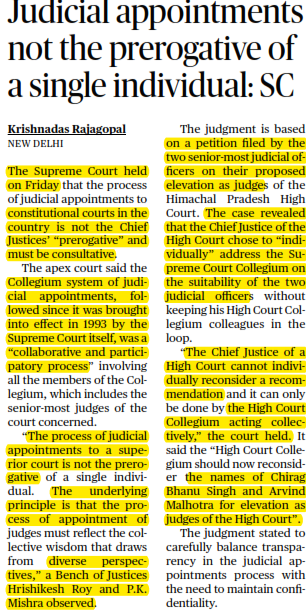
Judicial appointments not the prerogative of a single individual: SC
- The apex court said the Collegium system of judicial appointments was a “collaborative and participatory process” involving all the members of the Collegium.
Highlights:
- The Supreme Court, in a judgment on September 6, 2024, clarified that judicial appointments to constitutional courts must follow a collaborative and participatory process, rather than being the prerogative of the Chief Justices.
- The Court stressed that the Collegium system, established in 1993, involves consultation among senior-most judges, ensuring transparency and accountability in appointments.
Nature of the Collegium System:
- The Collegium system, formed in 1993 through the Second Judges case, institutionalized the practice of consulting senior colleagues.
- It includes the senior-most judges of the concerned court, with the goal of reflecting collective wisdom in judicial appointments.
- The Court emphasized that a single individual, including the Chief Justice, cannot make decisions unilaterally, as the appointment process should embody diverse perspectives.
Case Background: Himachal Pradesh High Court:
- The ruling stems from a petition by two senior judicial officers of Himachal Pradesh on their proposed elevation to the Himachal Pradesh High Court.
- The Chief Justice of the High Court had made an independent recommendation to the Supreme Court Collegium without consulting the other members of the High Court Collegium.
- The Supreme Court found this approach procedurally and substantially flawed, reaffirming that such decisions require collective deliberation by the High Court Collegium.
The Second and Third Judges Cases:
- The Court cited the Second Judges case (1993), which had effectively ended the primacy of the Chief Justice over senior colleagues, mandating their inclusion in the decision-making process. Additionally, the Third Judges case reinforced the need for plurality of opinion in the formation of the Chief Justice’s recommendations.
- This plurality checks arbitrariness, builds public trust in the judiciary, and ensures that appointments are based on thorough consideration.
Supreme Court’s Role in the Process:
- The Supreme Court clarified that its Collegium does not act as an appellate body over High Court Collegiums. Judicial appointments are a participatory process, where all constitutional functionaries, including both the Supreme Court and High Court Collegiums, play a role.
- The Chief Justice of a High Court cannot act alone, even if communications from the Supreme Court Collegium are addressed specifically to them.
Judicial Review and Confidentiality:
- The Court noted that the scope of judicial review in appointments is limited. It is invoked only in cases of ineffective consultation or questions regarding the eligibility of proposed candidates.
- The judgment also emphasized a balance between transparency and confidentiality in the appointment process, cautioning that disclosing sensitive information could compromise both privacy and the integrity of the judicial system.
Prelims Takeaways:
- Collegium system