
Keep raising road-infra spending, frame policies to boost electrification
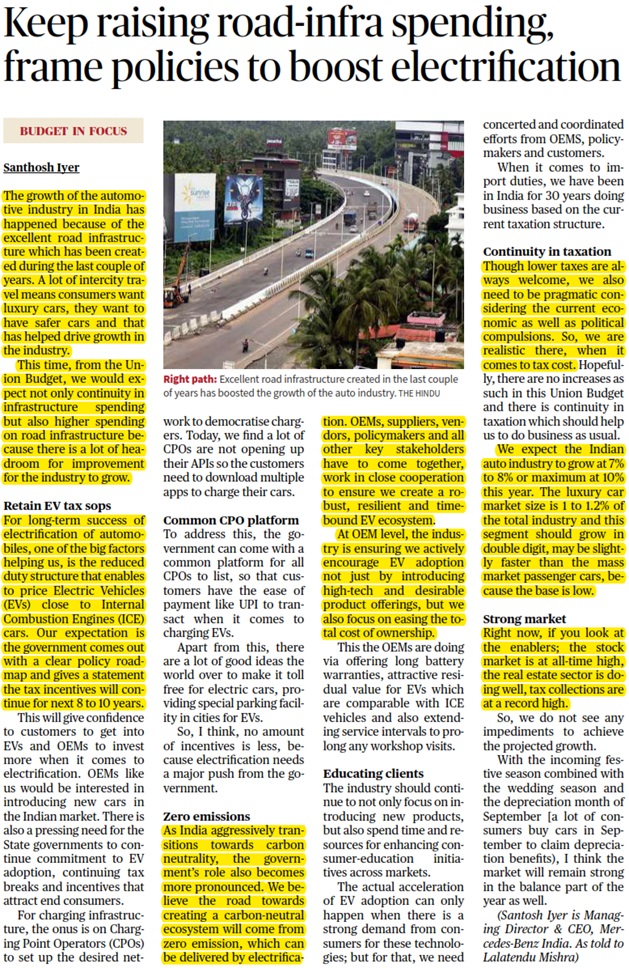
- The growth of the automotive industry in India has happened because of the excellent road infrastructure which has been created during the last couple of years.
- A lot of intercity travel means consumers want luxury cars, they want to have safer cars and that has helped drive growth in the industry.
- This time, from the Union Budget, we would expect not only continuity in infrastructure spending but also higher spending on road infrastructure because there is a lot of headroom for improvement for the industry to grow.
Retain EV tax sops
- For long-term success of electrification of automobiles, one of the big factors helping us, is the reduced duty structure that enables the price of Electric Vehicles (EVs) close to Internal Combustion Engines (ICE) cars.
- Our expectation is that the government comes out with a clear policy roadmap and gives a statement that tax incentives will continue for next 8 to 10 years.
- This will give confidence to customers to get into EVs and OEMs to invest more when it comes to electrification.
- For charging infrastructure, the onus is on Charging Point Operators (CPOs) to set up the desired network to democratize chargers.
- Today, we find a lot of CPOs are not opening up their APIs so the customers need to download multiple apps to charge their cars.
Common CPO platform
- To address this, the government can come up with a common platform for all CPOs to list, so that customers have the ease of payment like UPI to transact when it comes to charging EVs.
- Apart from this, there are a lot of good ideas the world over to make it toll free for electric cars, providing special parking facilities in cities for EVs.
- So, I think, no amount of incentives is less, because electrification needs a major push from the government.
Zero emissions
- As India aggressively transitions towards carbon neutrality, the government’s role also becomes more pronounced. We believe the road towards creating a carbon-neutral ecosystem will come from zero emission, which can be delivered by electrification. OEMs, suppliers, vendors, policymakers and all other key stakeholders have to come together, work in close cooperation to ensure we create a robust, resilient and time-bound EV ecosystem.
- At the OEM level, the industry is ensuring we actively encourage EV adoption not just by introducing high-tech and desirable product offerings, but we also focus on easing the total cost of ownership.
- This the OEMs are doing via offering long battery warranties, attractive residual value for EVs which are comparable with ICE vehicles and also extending service intervals to prolong any workshop visits.
Educating clients
- The industry should continue to not only focus on introducing new products, but also spend time and resources on enhancing consumer-education initiatives across markets.
- The actual acceleration of EV adoption can only happen when there is a strong demand from consumers for these technologies; but for that, we need concerted and coordinated efforts from OEMS, policymakers and customers.
- When it comes to import duties, we have been in India for 30 years doing business based on the current taxation structure.
Continuity in taxation
- Though lower taxes are always welcome, we also need to be pragmatic considering the current economic as well as political compulsions. So, we are realistic there, when it comes to tax cost. Hopefully, there are no increases as such in this Union Budget and there is continuity in taxation which should help us to do business as usual.
- We expect the Indian auto industry to grow at 7% to 8% or maximum at 10% this year.
Strong market
- Right now, if you look at the enablers; the stock market is at all-time high, the real estate sector is doing well, tax collections are at a record high.
- So, we do not see any impediments to achieve the projected growth.