
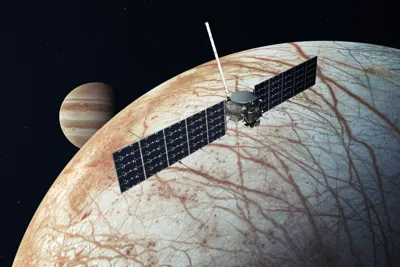
NASA's Europa Clipper Mission: Journey to Jupiter's Moon Europa
| Summary/Static | Details |
|---|---|
| Launch Date | October 14, 2024 |
| Launch Time | 12:06 p.m. EDT |
| Launch Vehicle | SpaceX Falcon Heavy |
| Launch Site | Kennedy Space Center, Florida |
| Primary Mission Goal | To explore whether Europa's subsurface ocean has conditions to support life |
| Distance to Jupiter | 1.8 billion miles (2.9 billion kilometers) |
| Expected Arrival | April 2030 |
| Number of Flybys | 49 flybys of Europa |
| Closest Approach | 16 miles (25 kilometers) from Europa's surface |
| Mission Significance | NASA's first dedicated mission to study an ocean world beyond Earth |
| Spacecraft Size | Largest interplanetary spacecraft built by NASA |
| Science Instruments | Ice-penetrating radar, cameras, thermal sensors (total of nine instruments) |
| Solar Arrays | Largest solar arrays on an interplanetary mission (100 feet/30.5 meters span) |
| Gravity Assists | Mars flyby in 2025, Earth flyby in 2026 |
| Previous Missions | Galileo Mission in the 1990s provided evidence of Europa's subsurface ocean |
| Science Objectives | Measure ice crust thickness, study surface for organic compounds, investigate tectonic activity and water plumes |
| Communication | Established with NASA's Deep Space Network in Canberra, Australia |
| Team Effort | Over 4,000 people contributed to the mission |