
‘Need stronger aviation ecosystem to brace for fleet doubling in 5-6 years’
- The privatisation of Air India has triggered a strategic transformation in the country’s airline sector.
Highlights:
- This was a remarkable milestone and the boldest reform since the second wave of liberalisation that commenced in financial year 2004.
- At the time of Air India’s acquisition, CAPA India had anticipated this would be a critical inflection point that would stabilise the airline system which, in turn, would have a positive impact on the entire value chain, possibly even beyond the borders of India.
- Last year, Air India placed an order for a record 470 aircraft, with the option to add another 370 aircraft.
- The group added 40 aircraft last year and is expecting to take delivery of five aircraft a month for the near to the medium term.
- Meanwhile, India’s largest airline IndiGo, which has a fleet of about 370 aircraft with more than 980 on order, continues to grow rapidly, despite supply-chain challenges that have fettered growth plans of airlines globally.
- This means the country’s airline fleet of almost 700 aircraft could double by the financial year 2030.
- It took the Indian industry about 90 years from the time of the first commercial flight to reach a fleet size of 700 aircraft.
- But the rate of growth is so strong that carriers could add a further 600-700 aircraft in just the next 5-7 years.
Irreversible stability
- We have a solid and aggressive airline system with the size, scale, aircraft orders and strategic intent to emerge as world-class operators.
- Air India’s investment of $6.5 billion in its business plan is a reflection of this. IndiGo reported record profitability of approximately $1 billion in FY2024, with another year of unprecedented results expected in FY2025.
- Despite there being about 150 aircraft on the ground last year, domestic traffic grew by about 13% in FY2024 and international by 22%.
Way Forward
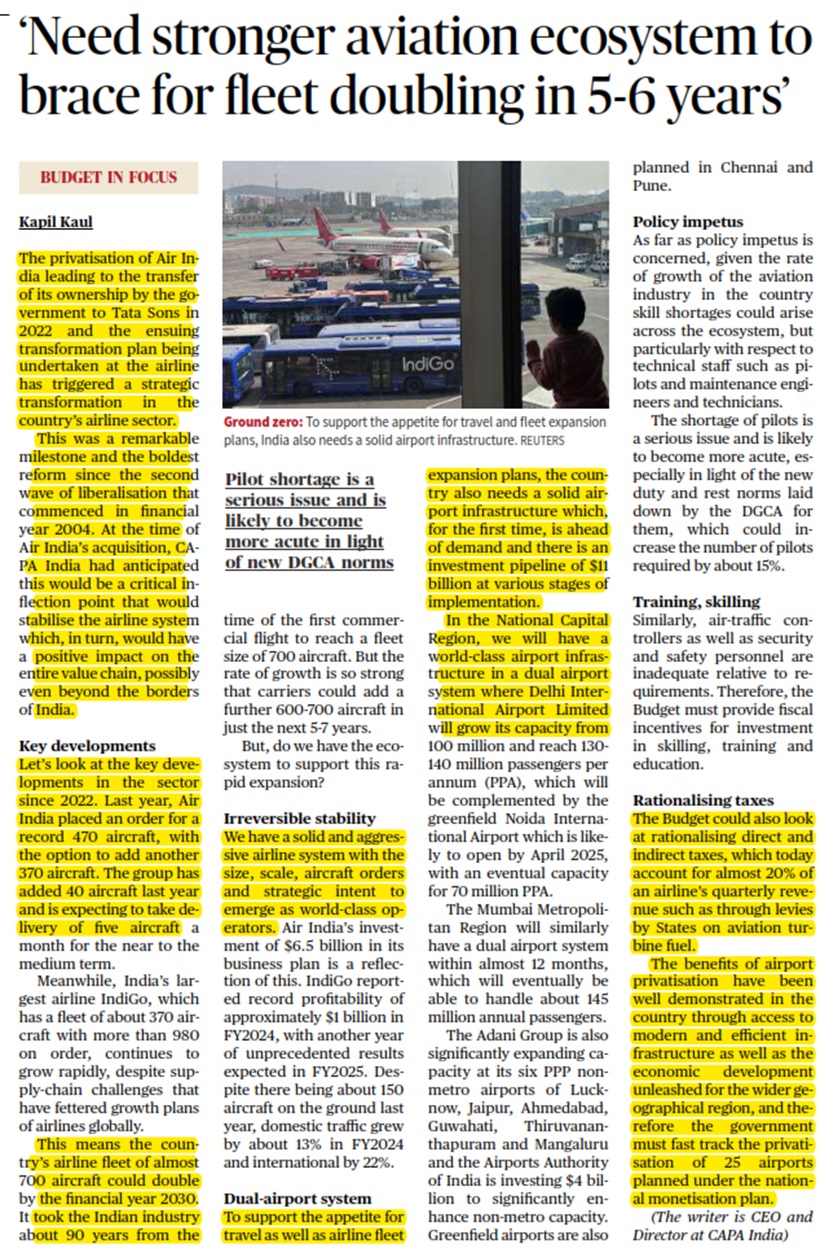
- To support the appetite for travel as well as airline fleet expansion plans, the country also needs a solid airport infrastructure which, for the first time, is ahead of demand and there is an investment pipeline of $11 billion at various stages of implementation.
- The shortage of pilots is a serious issue and is likely to become more acute, especially in light of the new duty and rest norms laid down by the DGCA for them, which could increase the number of pilots required by about 15%.
- Similarly, air-traffic controllers as well as security and safety personnel are inadequate relative to requirements.
- Therefore, the Budget must provide fiscal incentives for investment in skilling, training and education.
- The Budget could also look at rationalising direct and indirect taxes, which today account for almost 20% of an airline’s quarterly revenue such as through levies by States on aviation turbine fuel.
- The benefits of airport privatisation have been well demonstrated in the country through access to modern and efficient infrastructure as well as the economic development unleashed for the wider geographical region, and therefore the government must fast track the privatisation of 25 airports planned under the national monetisation plan.
Prelims Takeaway
- Privatisation