
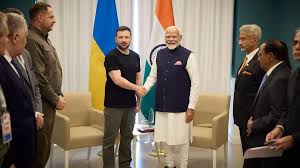
Negotiating for peace : India’s decision to attend but not vote at the Swiss conference was right
- The two-day “Summit on Peace”, in Burgenstock , met with mixed outcomes.
- Switzerland was able to bring together more than 90 countries, at least 56 were represented by leaders
- and the final joint communiqué was signed by about 82 countries and organisations, with the exception of a few including India.
KEY HIGHLIGHTS
- The document made a strong call for an end to the “ongoing war of the Russian Federation against Ukraine” and a pitch for sovereignty, territorial integrity and adherence to international law.
- It cited three areas of broad understanding: nuclear safety, food security and the exchange of all prisoners of war, displaced and detained Ukrainians.
- However, despite all these areas where Ukrainian President Zelenskyy hailed a “historic victory”, there were shortcomings.
- Switzerland’s decision not to invite Russia, and to build their negotiations on the basis of the Ukraine Peace Formula along with UN resolutions, made the event appear one-sided.
- The failure in convincing China, which arguably holds the most sway over Moscow, to even send a delegation was another blow.
- That no BRICS member, current and future, signed on to the statement indicates that it was a non-starter among the emerging economies.
- As a close partner of Russia, a key Global South player, and a country that has kept a balance in the conflict, India’s presence would have been a major win for the organisers.
- While India may share concerns over much of the text released at the conference, it could not have gone ahead with its overtly anti-Russian slant.
- In its presence, however, New Delhi showed that it is willing to be part of the process,
- especially if it leads to a more inclusive future conference, with Russia and Ukraine at the table.
- As a result, India’s decision to attend the conference, but not endorse its outcome, was probably a foregone conclusion.
Prelims takeaway
- Map based questions