
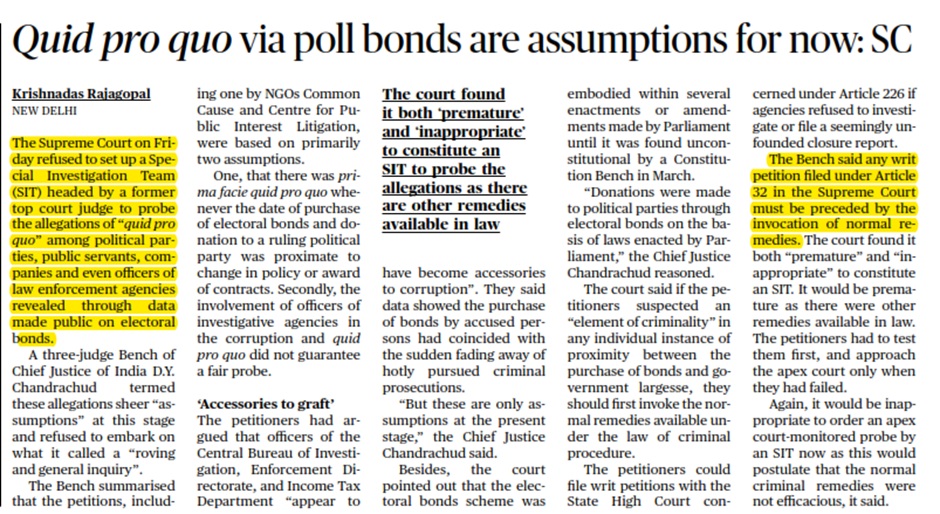
Quid pro quo via poll bonds are assumptions for now: SC
- The Supreme Court refused to set up a Special Investigation Team (SIT) to probe allegations of “quid pro quo” among political parties, public servants, and companies revealed through data made public on electoral bonds.
Highlights:
- A three-judge Bench termed these allegations sheer “assumptions” at this stage and refused to embark on what it called a “roving and general inquiry”.
- The Bench summarised that the petitions, including one by NGOs Common Cause and Centre for Public Interest Litigation were based on primarily two assumptions.
- One, that there was prima facie quid pro quo whenever the date of purchase of electoral bonds and donation to a ruling political party was proximate to change in policy or award of contracts.
- Secondly, the involvement of officers of investigative agencies in the corruption and quid pro quo did not guarantee a fair probe.
- The petitioners had argued that officers of the CBI, Enforcement Directorate and the Income Tax Department appear to have become accessories to corruption.
- Besides, the court pointed out that the electoral bonds scheme was embodied within several enactments or amendments made by the Parliament until it was found unconstitutional by a Constitution Bench of the Supreme Court in March 2024.
- The Bench said any writ petition filed under Article 32 in the Supreme Court must be preceded by the invocation of normal remedies.
- Again, it would be inappropriate to order an apex court-monitored probe by an SIT now as this would postulate that the normal criminal remedies were not efficacious.
- The Constitution Bench had intervened to strike down the electoral bonds scheme after examining their constitutional validity. This exercise was distinct from entertaining mere allegations of criminal wrongdoing, the CJI distinguished.
- The court declined to order Income Tax authorities to reopen the assessments of political parties, saying it was “inappropriate”.
- In its March 2024 judgment, a Constitution Bench had held that the electoral bonds scheme violated the public’s right to know about political funding and freedom of speech and expression.
Prelims Takeaway
- Electoral Bonds