
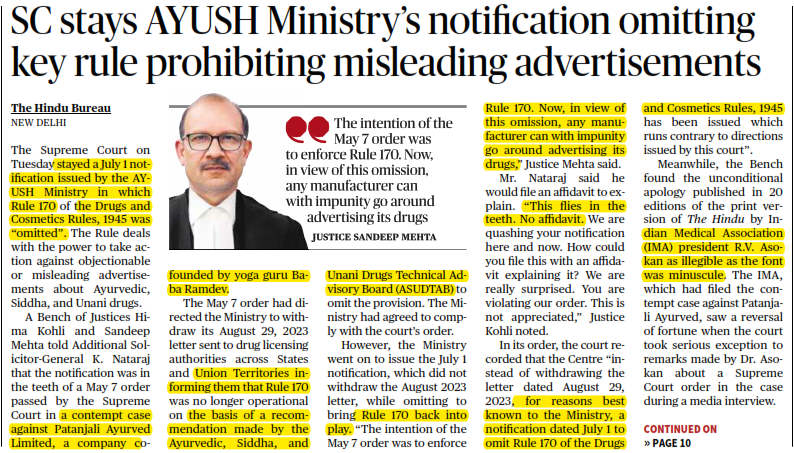
SC stays AYUSH ministry’s notification omitting key rule prohibiting misleading advertisement
- The notification was in the teeth of a May 2024 order passed by the Supreme Court in a contempt case against Patanjali Ayurved Limited, the company co-founded by yoga guru Baba Ramdev
Highlights:
- On August 27, 2024, the Supreme Court of India took a decisive step by staying a July 1, 2024 notification issued by the AYUSH Ministry.
- This notification had omitted Rule 170 of the Drugs and Cosmetics Rules, 1945, a crucial provision that empowers authorities to act against misleading advertisements related to Ayurvedic, Siddha, and Unani drugs.
- The Court's intervention highlights the ongoing tension between regulatory frameworks and the need to protect public interest in the health sector.
Background:
- Rule 170 of the Drugs and Cosmetics Rules, 1945, plays a pivotal role in safeguarding consumers from objectionable or misleading advertisements concerning traditional medicine systems like Ayurveda, Siddha, and Unani.
- The omission of this rule by the AYUSH Ministry raised significant concerns, particularly given its direct conflict with a prior Supreme Court order dated May 7, 2024.
- In the May 7 order, the Supreme Court had directed the AYUSH Ministry to withdraw an August 29, 2023 letter that informed state and union territory drug licensing authorities that Rule 170 was no longer operational.
- This letter was based on a recommendation by the Ayurvedic, Siddha, and Unani Drugs Technical Advisory Board (ASUDTAB). The Ministry had agreed to comply with the court's direction but later issued the July 1 notification, omitting Rule 170 altogether.
Legal Implications:
- The Supreme Court's stay on the AYUSH Ministry's notification is significant from a legal standpoint. The Court made it clear that the July 1 notification was in direct violation of its May 7 order.
- Justice Sandeep Mehta emphasized that omitting Rule 170 would allow manufacturers to advertise their drugs without regulatory oversight, potentially leading to a surge in misleading advertisements.
- The Court's stern response to the Ministry's actions underscores the importance of judicial oversight in maintaining the integrity of regulatory frameworks.
The Role of Rule 170:
- Rule 170 is a critical regulatory tool that ensures accountability in the advertising of Ayurvedic, Siddha, and Unani drugs.
- By allowing authorities to take action against misleading claims, this rule protects consumers from being misled by false promises.
- The omission of this rule could have far-reaching consequences, including the erosion of consumer trust in traditional medicine systems and potential public health risks.
Judiciary's Protective Role:
- The Supreme Court's intervention reflects its role as a guardian of public interest.
- The Court's swift action to stay the notification demonstrates its commitment to ensuring that regulatory provisions are not diluted, especially when they impact public health and consumer rights.
- This case serves as a reminder of the judiciary's crucial function in upholding the rule of law and preventing executive overreach.
Prelims Takeaways:
- ASUDTAB