
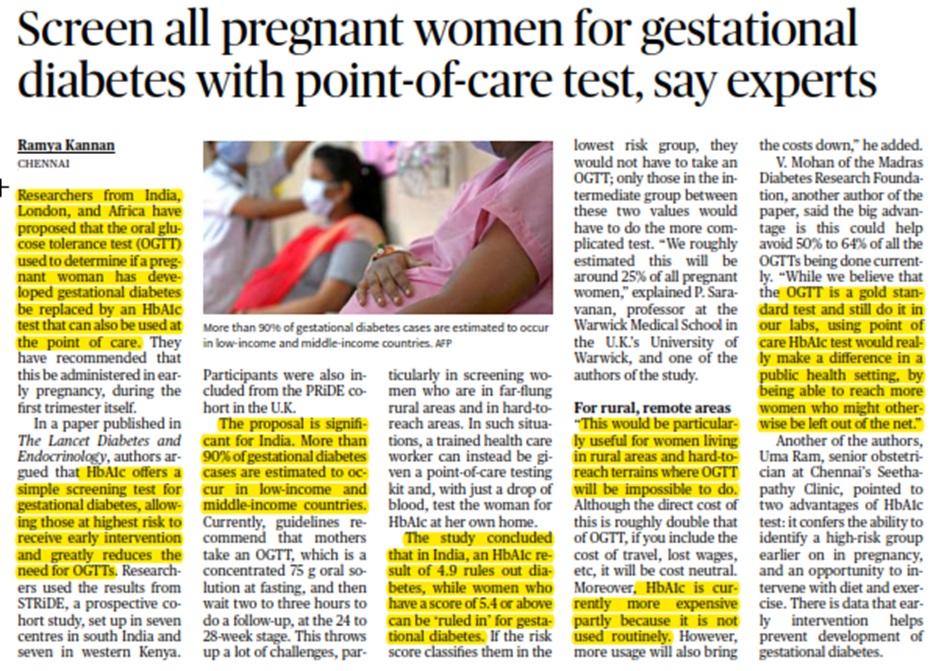
Screen all pregnant women for gestational diabetes with point-of-care test, say experts
- Researchers from India, London, and Africa have proposed that the oral glucose tolerance test (OGTT) be replaced by an HbA1c test
Highlights:
- They have recommended that this be administered in early pregnancy, during the first trimester itself.
- In a paper published in The Lancet Diabetes and Endocrinology, authors argued that HbA1c offers a simple screening test for gestational diabetes, allowing those at highest risk to receive early intervention and greatly reduces the need for OGTTs.
- The proposal is significant for India. As more than 90% of gestational diabetes cases are estimated to occur in low-income and middle-income countries.
- Currently, guidelines recommend that mothers take an OGTT, which is a concentrated 75 g oral solution at fasting, and then wait two to three hours to do a follow-up, at the 24 to 28-week stage.
- This throws up a lot of challenges, particularly in screening women who are in far-flung rural areas and in hard-to-reach areas.
- The study concluded that in India, an HbA1c result of 4.9 rules out diabetes, while women who have a score of 5.4 or above can be ‘ruled in’ for gestational diabetes.
- If the risk score classifies them in the lowest risk group, they would not have to take an OGTT; only those in the intermediate group between these two values would have to do the more complicated test.
- Advantages of HbA1c test: it confers the ability to identify a high-risk group earlier on in pregnancy, and an opportunity to intervene with diet and exercise.
- There is data that early intervention helps prevent development of gestational diabetes.
Prelims Takeaway
- HbA1c
- Gestational Diabetes