
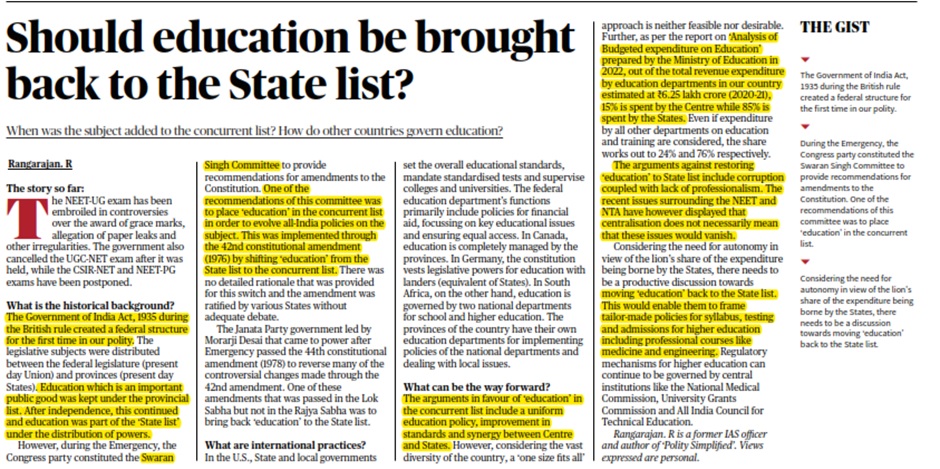
Should education be brought back to the State list?
- The recent NEET-UG exam has been embroiled in controversies over the award of grace marks, allegation of paper leaks and other irregularities.
- This puts a lot of questions on whether ‘Education’ should go back to being a state subject.
Historical Background
- The Government of India Act, 1935 during the British rule created a federal structure for the first time in our polity.
- The legislative subjects were distributed between the federal legislature (present day Union) and provinces (present day States).
- Education, which is an important public good, was kept under the provincial list.
- After independence, this continued and education was part of the ‘State list’ under the distribution of powers.
- However, during the Emergency Swaran Singh Committee was constituted to provide recommendations for amendments to the Constitution.
- One of the recommendations of this committee was to place ‘education’ in the concurrent list in order to evolve all-India policies on the subject.
- This was implemented through the 42nd constitutional amendment (1976) by shifting ‘education’ from the State list to the concurrent list.
- Historical Background
- The Government of India Act, 1935 during the British rule created a federal structure for the first time in our polity.
- The legislative subjects were distributed between the federal legislature (present day Union) and provinces (present day States).
- Education, which is an important public good, was kept under the provincial list.
- After independence, this continued and education was part of the ‘State list’ under the distribution of powers.
- However, during the Emergency Swaran Singh Committee was constituted to provide recommendations for amendments to the Constitution.
- One of the recommendations of this committee was to place ‘education’ in the concurrent list in order to evolve all-India policies on the subject.
- This was implemented through the 42nd constitutional amendment (1976) by shifting ‘education’ from the State list to the concurrent list.
International practices
- In the U.S., State and local governments set the overall educational standards, mandate standardised tests and supervise colleges and universities.
- The federal education department’s functions primarily include policies for financial aid, focussing on key educational issues and ensuring equal access.
- In Canada, education is completely managed by the provinces.
- In Germany, the constitution vests legislative powers for education with landers (equivalent of States).
- In South Africa, on the other hand, education is governed by two national departments for school and higher education.
- The provinces of the country have their own education departments for implementing policies of the national departments and dealing with local issues.
Way forward
- The arguments in favour of ‘education’ in the concurrent list include a uniform education policy, improvement in standards and synergy between Centre and States.
- Considering the vast diversity of the country, a ‘one size fits all’ approach is neither feasible nor desirable.
- As per ‘Analysis of Budgeted expenditure on Education’ prepared by the Ministry of Education in 2022, out of the total revenue expenditure by education departments in our country 15% is spent by the Centre while 85% is spent by the States.
- The arguments against restoring ‘education’ to the State list include corruption coupled with lack of professionalism.
- The recent issues surrounding recent exams have however displayed that centralisation does not necessarily mean that these issues would vanish.
- Bringing back education to the state list would enable them to frame tailor-made policies for syllabus, testing and admissions for higher education including professional courses like medicine and engineering.
- Regulatory mechanisms for higher education can continue to be governed by central institutions like the National Medical Commission, University Grants Commission and All India Council for Technical Education.