
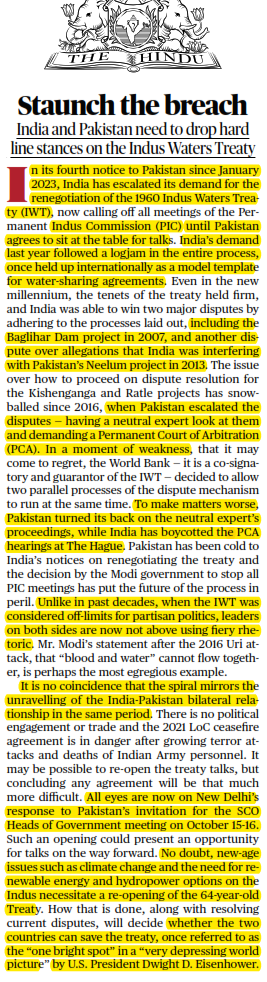
Staunch the breach
- In its fourth notice since January 2023, India has intensified its demand for renegotiating the 1960 Indus Waters Treaty (IWT), suspending all meetings of the Permanent Indus Commission (PIC) until Pakistan agrees to discuss the treaty.
- This move signifies the growing tension between the two countries over water-sharing disputes. The IWT, once lauded as a model of effective water-sharing agreements, has faced a significant impasse in recent years.
Key Historical Disputes:
- The IWT, which weathered numerous challenges since its inception, had successfully resolved disputes like the Baglihar Dam project (2007) and issues regarding India’s involvement in Pakistan’s Neelum project (2013).
- However, the latest disputes over India’s Kishenganga and Ratle projects have exacerbated tensions. In 2016, Pakistan escalated the matter by seeking both a neutral expert and a Permanent Court of Arbitration (PCA), leading to complications in the dispute resolution process.
- The World Bank, acting as a co-signatory and guarantor of the treaty, made a controversial decision to allow both processes to proceed simultaneously, resulting in further confusion.
- While Pakistan abandoned the neutral expert’s proceedings, India has boycotted the PCA hearings in The Hague. India’s decision to halt all PIC meetings indicates the seriousness of its stance, putting the IWT's future at risk.
Political Rhetoric and the Erosion of Bilateral Trust:
- The IWT was traditionally insulated from partisan politics, but recent years have seen it entangled in fiery rhetoric. For instance, Prime Minister Modi’s 2016 statement post the Uri attack — "blood and water cannot flow together" — marked a significant departure from the past diplomatic tone.
- This hardening of positions mirrors the broader deterioration in India-Pakistan relations, marked by the lack of political dialogue, suspended trade, and the jeopardized 2021 LoC ceasefire agreement due to escalating terror attacks.
Prospects for Dialogue and Reinvigorating the Treaty:
- Despite the current deadlock, opportunities exist for diplomatic engagement. Pakistan’s invitation to India for the SCO Heads of Government meeting on October 15-16 could serve as a potential avenue for reopening dialogue.
- Modern issues such as climate change, the need for renewable energy, and hydropower development on the Indus River necessitate revisiting and updating the 64-year-old treaty.
Conclusion:
- The fate of the IWT hinges on the willingness of both nations to navigate their long-standing disputes and adapt to emerging challenges.
- Revisiting the treaty in light of contemporary issues, while resolving current disagreements, will be pivotal in determining whether India and Pakistan can salvage this critical framework, once hailed by U.S. President Dwight D. Eisenhower as the "one bright spot" in an otherwise "very depressing world picture."