
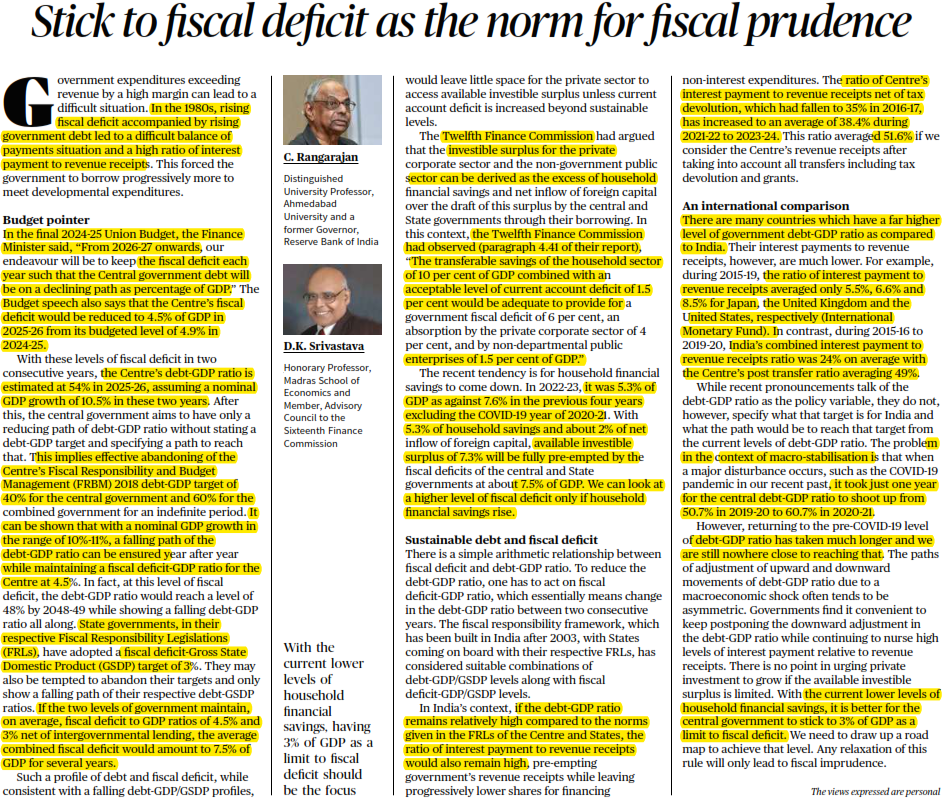
Stick to fiscal deficit as the norm for fiscal prudence
- The article examines the consequences of government expenditures exceeding revenues, focusing on India's fiscal deficit and debt management.
- It highlights historical challenges, current fiscal policies, and the significance of maintaining fiscal discipline.
Historical Context: Fiscal Deficit and Debt
- In the 1980s, India struggled with rising fiscal deficits and government debt, leading to a high interest payment-to-revenue ratio.
- This created a balance of payments crisis, forcing the government to borrow more to fund developmental expenditures.
Current Fiscal Policy
- The 2024-25 Union Budget aims to reduce the fiscal deficit, targeting 4.5% of GDP by 2025-26.
- The government's plan is to gradually reduce the debt-to-GDP ratio to 54% by 2025-26, with a focus on long-term fiscal consolidation.
Abandoning FRBM Debt Targets
- The government appears to be moving away from the Fiscal Responsibility and Budget Management (FRBM) Act’s 40% debt-to-GDP target for the central government.
- Instead, it aims for a declining debt-to-GDP ratio without specifying a target, with an estimated 48% debt-to-GDP ratio by 2048-49.
- State governments may also relax their fiscal targets, potentially pushing the combined fiscal deficit to 7.5% of GDP.
Impact on Private Sector Investment
- A high fiscal deficit limits the private sector’s access to investible surplus unless household savings increase.
- The Twelfth Finance Commission highlighted that household savings and foreign capital inflows are key to funding private investment.
- Household financial savings dropped to 5.3% of GDP in 2022-23, meaning almost all investible surplus is consumed by government borrowing.
Fiscal Deficit and Debt Relationship
- There is a direct link between fiscal deficit and the debt-to-GDP ratio, as a high deficit raises debt levels.
- This increases interest payments, reducing the government's ability to finance developmental projects.
- Between 2021-24, the central government’s interest payments averaged 38.4% of revenue receipts, further straining fiscal resources.
International Comparison
- India’s debt-to-GDP ratio is lower than some advanced economies, but its interest payment-to-revenue receipts ratio is significantly higher.
- Between 2015-19, Japan, the UK, and the US had interest payment ratios of 5.5%, 6.6%, and 8.5%, respectively, while India’s ratio averaged 24%.
The Path Forward: Reducing Fiscal Deficit
- The article stresses the importance of reducing India’s fiscal deficit to 3% of GDP to ensure long-term financial stability.
- Lowering the debt-GDP ratio is essential to create space for private investment and avoid fiscal imprudence.
Conclusion
- Strict fiscal discipline is necessary to prevent long-term economic challenges.
- The central government must focus on reducing the fiscal deficit to 3% of GDP to create more room for private investment and economic growth.