
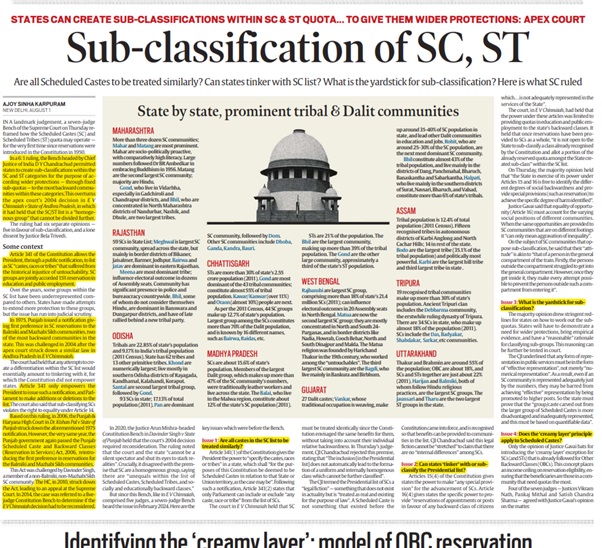
Supreme Court’s verdict on sub-classification of SCs and STs
- On August 1, the Supreme Court, in a 6:1 majority decision, ruled that sub-classification within the Scheduled Castes (SCs) and Scheduled Tribes (STs) is permissible to enhance the benefits of affirmative action.
- However, the seven-judge Bench, led by Chief Justice of India (CJI) D.Y. Chandrachud, underscored that such sub-classification must be based on "quantifiable and demonstrable data" rather than political considerations.
- Sub-classification
Sub-classification
- Sub-classification enables the identification of the most disadvantaged groups, ensuring that the benefits of affirmative action are more equitably distributed.
- Sub-classification seeks to create separate quotas within the SC category for these underrepresented groups, thereby promoting fairness and equity in the allocation of affirmative action benefits.
- The Supreme Court's majority opinion cited historical and empirical evidence showing that specific castes within the SCs face greater levels of oppression and discrimination.
- The ruling mandates that any sub-classification must be grounded in "quantifiable and demonstrable data" concerning levels of backwardness and representation, ensuring transparency and accountability in the process.
Creamy Layer Principle
- The creamy layer principle involves excluding the more affluent and socially advanced members within a backward class from receiving reservation benefits.
- While this principle currently applies to Other Backward Classes (OBCs), there has been discussion about extending it to SCs and STs as well.
- Justice B.R. Gavai, in his concurring opinion, stressed the importance of states identifying and excluding the creamy layer within SCs and STs to ensure that the benefits of affirmative action reach those who are genuinely disadvantaged.
- The creamy layer principle has been upheld in various Supreme Court judgments, including the landmark Indra Sawhney case in 1992, which recognized that certain individuals within reserved categories who have attained higher socio-economic status should not benefit from reservations intended for the disadvantaged.
Way Forward
- States should prioritize the collection of comprehensive and quantifiable data on the socio-economic conditions of different castes within the SC and ST categories.
- States should develop clear policies to identify and exclude the creamy layer within SCs and STs from reservation benefits, ensuring that affirmative action targets the most disadvantaged.