
THE GROWTH DRIVERS
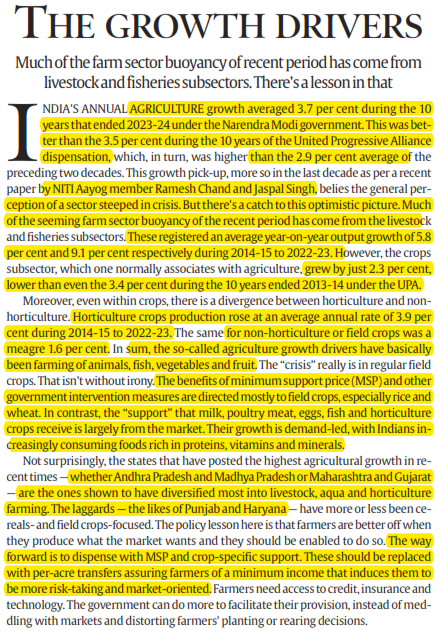
- India's agricultural sector has exhibited noteworthy growth in the past decade, with an annual growth rate averaging 3.7% during the tenure of the Narendra Modi government (2014-2024).
- This figure surpasses the 3.5% growth rate observed during the United Progressive Alliance (UPA) government and represents a significant improvement from the 2.9% average growth rate in the two decades preceding the Modi administration.
- However, beneath this seemingly positive performance lies a complex landscape of challenges, particularly in traditional crop production.
Growth Drivers: Livestock and Fisheries
Sector-Specific Performance:
- The apparent buoyancy in the agricultural sector can be attributed largely to the growth in the livestock and fisheries subsectors, which achieved impressive average year-on-year growth rates of 5.8% and 9.1%, respectively, from 2014-15 to 2022-23.
- In stark contrast, the crops subsector—the cornerstone of traditional agriculture—grew at a modest 2.3% during the same period. This growth rate is not only lower than the overall agricultural growth but also below the 3.4% rate seen during the last decade of the UPA government.
Horticulture vs. Non-Horticulture:
- A closer examination of crop production reveals a further divergence: horticulture crops (fruits and vegetables) saw an average annual growth rate of 3.9%, whereas non-horticulture or field crops struggled with a mere 1.6% growth.
- This indicates that the most dynamic segments of agriculture are not aligned with the traditional staples, such as rice and wheat, which are the focus of government support through the Minimum Support Price (MSP) program.
The Crisis in Traditional Agriculture:
- The so-called agricultural growth narrative is somewhat misleading. While livestock and horticulture are thriving, the traditional field crops sector appears to be in crisis. The irony lies in the fact that government interventions like the MSP, intended to bolster farmer incomes, primarily benefit these struggling field crops.
- Despite government efforts, many farmers remain reliant on market dynamics for livestock and horticulture, indicating a shift towards more profitable and demand-driven farming practices.
Regional Disparities in Agricultural Growth:
- States exhibiting robust agricultural growth, such as Andhra Pradesh, Madhya Pradesh, Maharashtra, and Gujarat, have successfully diversified their agricultural practices, leaning more towards livestock, aqua farming, and horticulture.
- Conversely, traditional agrarian states like Punjab and Haryana, which remain focused on cereals and field crops, are lagging behind. This disparity highlights the need for a more market-oriented approach to agriculture.
Policy Recommendations for Future Growth
Market-Oriented Approaches:
- To address the challenges facing traditional agriculture, a shift away from MSP and crop-specific support is necessary. Instead, policies should focus on providing per-acre income transfers that incentivize farmers to diversify their production based on market demand.
- By enabling farmers to produce what the market wants, agricultural growth can become more sustainable and resilient.
Access to Resources:
- Ensuring that farmers have access to credit, insurance, and technology is crucial for fostering innovation and risk-taking in agriculture. The government should prioritize facilitating these provisions rather than intervening directly in market dynamics, which often distorts planting and rearing decisions.
Encouraging Diversification:
- Encouraging diversification in farming practices can lead to a more balanced and resilient agricultural sector. Policymakers must focus on empowering farmers to explore non-traditional crops and livestock farming, which can lead to higher incomes and improved food security.
Conclusion:
- India’s agricultural growth has seen significant improvements over the past decade, largely driven by livestock and horticulture. However, the challenges faced by traditional field crops underline the need for policy reform that encourages market-oriented practices and supports farmers in diversifying their production.
- By adopting a more holistic approach that emphasizes market demands and resource access, India can pave the way for a more robust and sustainable agricultural future.