
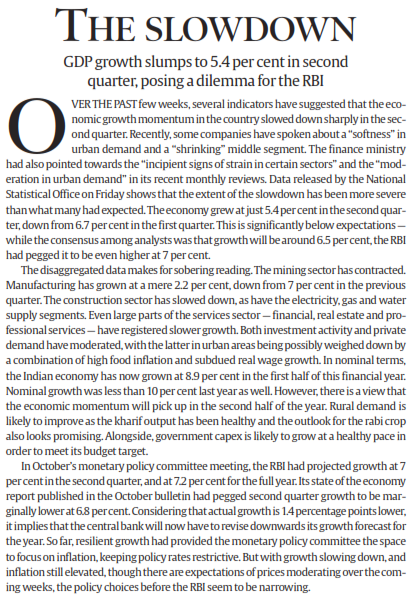
THE SLOWDOWN
- India’s real Gross Domestic Product (GDP) growth slumped to a seven-quarter low of 5.4% for the July-September 2024 period, driven primarily by sluggish performance in manufacturing and a deceleration in mining and quarrying, according to data released by the National Statistics Office (NSO).
Growth Breakdown: A Closer Look:
- Overall GDP Growth: The growth rate for Q2 is lower than the 6.7% recorded in the previous quarter (April-June 2024) and 8.1% in the same quarter last year (July-September 2023). This marks a significant drop from earlier periods and is at least a percentage point below consensus estimates made by economists.
- Manufacturing Sector: Manufacturing, which contributes over 17% to Gross Value Added (GVA), showed a significant slowdown, with growth dropping to 2.2% in Q2, down from 7% in Q1 and 14.3% in Q2 of 2023. Factors contributing to this slowdown include excess capacity and increased imports, which have dampened domestic manufacturing activity.
- Mining and Quarrying: The mining sector also faced a setback, contracting by 0.1% in Q2, compared to a growth of 7.2% in the previous quarter and 11.1% in the same period last year. The contraction was attributed to extended rainfall, which disrupted mining activities.
Bright Spots Amid the Slowdown:
- Despite the overall dip in growth, there were some positive signs in other sectors:
- Agriculture: The agriculture sector posted 3.5% growth in Q2, a notable improvement from 2% in Q1 and 1.7% in Q2 2023. This growth can be attributed to strong monsoon conditions and record production estimates for Kharif crops.
- Construction: The construction sector continued its robust performance, registering 7.7% growth in Q2, although it had grown at a higher rate of 10.5% in Q1 and 13.6% in the same period last year. The sustained growth in construction is indicative of continued investment in infrastructure projects.
- Services Sector: The services sector saw 7.1% growth in Q2, slower than expected but still positive. It grew at 7.2% in Q1 and 6% in the year-ago period. This suggests a stable services sector despite other challenges in manufacturing and mining.
Private and Government Consumption Trends:
- Private Final Consumption Expenditure (PFCE): PFCE, an indicator of domestic demand, grew by 6% in Q2, amounting to Rs 24.82 lakh crore. This growth was slower than the 7.4% in Q1 but significantly higher than the 2.6% growth recorded in Q2 2023, suggesting that demand is still robust but facing some headwinds.
- Government Consumption Expenditure: The government’s final consumption expenditure grew by 4.4% in Q2, a notable recovery from the 0.2% contraction in Q1. However, it was much lower than the 14% growth observed in the same period last year. Government spending was impacted by the Lok Sabha elections, but it showed signs of recovery in Q2.
Chief Economic Advisor’s Perspective:
- India’s Chief Economic Advisor (CEA), V Anantha Nageswaran, characterized the slowdown as “disappointing but not alarming.” According to him, while the growth figures were lower than expected, they should not be cause for panic. Several factors contributing to the slowdown were acknowledged, including the significant dip in manufacturing output.
- Nageswaran emphasized that to address these challenges and improve future growth prospects, policy reforms in the private sector, such as deregulation, improving hiring and compensation policies, and expanding state capacity for public investment, are essential. He argued that doubling down on deregulation and improving state investment would help the economy recover and turn the disappointing Q2 numbers into a "distant memory."
Outlook and Projections for the Full Year:
- Despite the current dip, Nageswaran remains optimistic about India’s growth potential for the remainder of the year. He noted that it was “too soon to say” that the 6.5-7% growth target for the fiscal year was at risk, and he cautioned against extrapolating too much from the Q2 performance.
- RBI’s Forecast: The Reserve Bank of India (RBI) has projected a 7.2% GDP growth rate for FY 2024-25, along with a 7.1% growth for FY 2025-26, suggesting that they anticipate a recovery in the coming quarters.
Sectoral Challenges and Potential Solutions
- The ongoing slowdown in manufacturing and mining raises concerns about cyclical growth patterns, which may continue to impact India's broader economic trajectory. However, Nageswaran suggested that policy interventions and structural reforms could support growth, especially in private sector employment and investment.
Conclusion
- The 5.4% GDP growth in Q2 2024 reflects a slowdown largely driven by challenges in the manufacturing and mining sectors. However, the bright spots in agriculture, construction, and services provide a balanced perspective.
- The government’s focus on deregulation, public investment, and improving private sector hiring and compensation policies will be critical in addressing the current slowdown and sustaining growth in the long term. As India moves toward its fiscal year targets, a continued focus on reforms and strategic investments could lead to recovery in the subsequent quarters.