
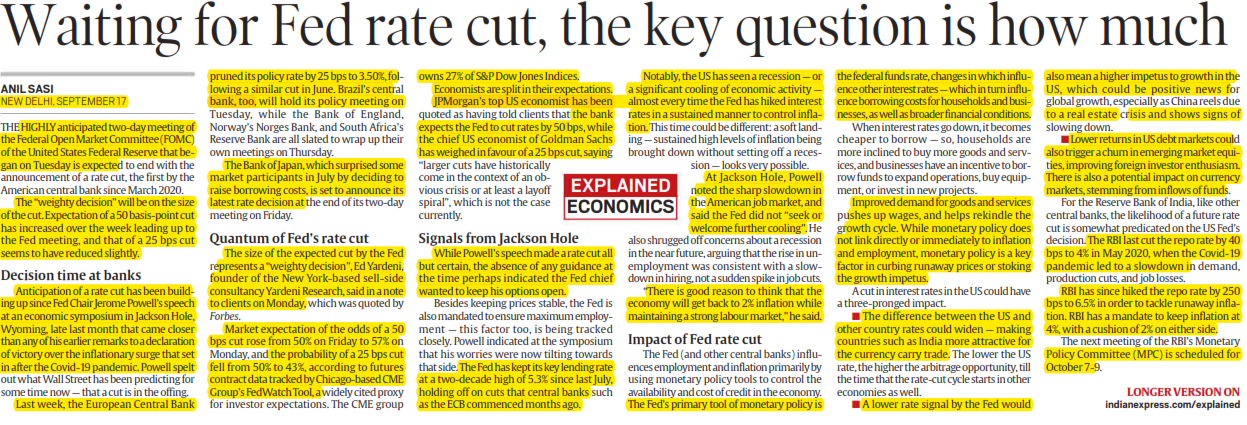
Waiting for fed rate cut, the key question is how much
- The much-anticipated Federal Open Market Committee (FOMC) meeting of the US Federal Reserve is expected to end with an announcement of a rate cut, the first since March 2020.
- This decision could have significant repercussions for global markets, including India, as central banks around the world are also recalibrating their monetary policies in response to evolving economic conditions.
Expected Rate Cut: A "Weighty Decision":
- Market predictions have fluctuated between a 25 basis-point and a 50 basis-point cut, with expectations of a 50 basis-point cut growing stronger in recent days. The Fed’s decision to embark on a rate-cutting cycle follows an extended period of holding rates at a two-decade high of 5.3% to combat inflation.
- The speech by Fed Chair Jerome Powell at the Jackson Hole symposium hinted at the likelihood of a cut, marking a shift from the Fed’s previous stance of focusing solely on inflation control to now also addressing concerns about employment.
Global Central Banks in Sync:
- The Fed’s decision comes as global central banks are already in the midst of their own rate-cutting cycles. Last week, the European Central Bank reduced its policy rate by 25 basis points, and central banks in countries like Brazil, South Africa, and Norway are also poised to announce their rate decisions soon.
- The Bank of Japan, which has been surprising markets with its decisions, is expected to conclude its own meeting later this week.
Powell’s Jackson Hole Speech: Key Signals:
- In his Jackson Hole address, Powell acknowledged the slowdown in the US job market and reassured markets that the rise in unemployment was consistent with a hiring slowdown rather than a surge in job cuts.
- He expressed optimism that the economy could return to 2% inflation while maintaining a strong labor market. This shift in focus from inflation control to employment concerns has increased the likelihood of a soft landing — bringing inflation down without triggering a recession.
Impact on India and Emerging Markets:
- A US rate cut could have a three-pronged impact on India and other emerging markets:
- Currency Carry Trade: A lower US rate would widen the difference between US and Indian interest rates, making India more attractive for currency carry trades. This arbitrage opportunity could lead to increased foreign fund inflows into India.
- Global Growth Impetus: A cut could stimulate US economic growth, providing a boost to global demand. This could be particularly beneficial at a time when China is grappling with a real estate crisis and slowing economic activity, which has dampened global growth prospects.
- Foreign Investor Sentiment: Lower returns in US debt markets could redirect foreign investment into emerging market equities, including India, potentially boosting stock market performance and foreign direct investment (FDI).
Impact on Indian Monetary Policy:
- For the Reserve Bank of India (RBI), a US rate cut could provide more room for future rate reductions. The RBI’s repo rate currently stands at 6.5%, following a series of hikes to curb inflation.
- However, with inflation still a concern, the RBI may follow the Fed’s lead in adjusting its policy depending on the evolving economic scenario.
- The upcoming RBI Monetary Policy Committee (MPC) meeting, scheduled for October 7-9, will be crucial in determining India’s next steps in managing inflation and promoting growth.
- With global markets watching the Fed’s decision closely, the RBI’s policy could be influenced by how the US central bank chooses to navigate its own economic challenges.
Conclusion:
- The Fed’s impending rate cut is a significant moment for both global and domestic economies, setting the stage for a rebalancing of monetary policies.
- While the Fed's decision is geared toward stabilizing the US economy, its effects will ripple through emerging markets like India, influencing interest rates, capital flows, and investor sentiment.
- As the global economy navigates a complex recovery, central banks around the world are closely coordinating their responses to ensure stability and growth.