
What is Enemy Agents Ordinance, tough law applicable in Jammu and Kashmir?
- J&K DGP said those found assisting militants in J&K should be tried by investigating agencies under the Enemy Agents Ordinance, 2005.
- The law is more stringent than the Unlawful Activities (Prevention) Act (UAPA) and has the punishment of either a life term or a death sentence.
- The fighters who can’t be brought under investigation, are shot dead.
- Those who support them, will be treated as enemy agents.
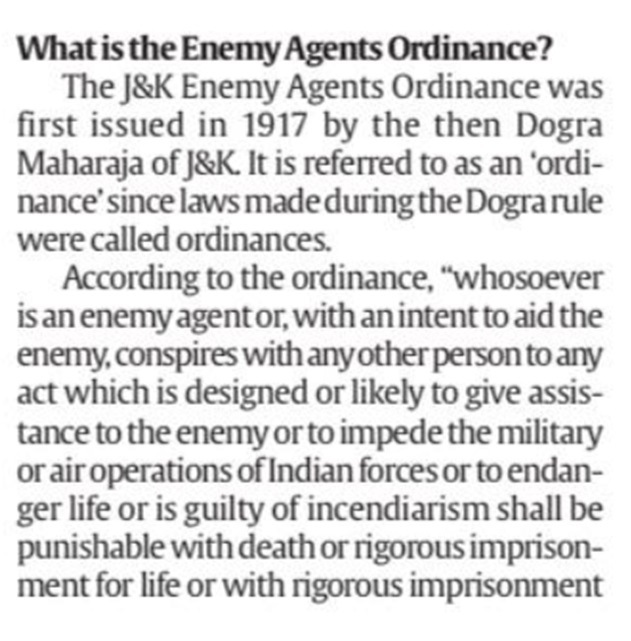
What is the Enemy Agents Ordinance?
- The J&K Enemy Agents Ordinance was first issued in 1917 by the then Dogra Maharaja of J&K. It is referred to as an ‘ordinance’ since laws made during the Dogra rule were called ordinances.
- According to the ordinance,
- “whosoever is an enemy agent or, with an intent to aid the enemy,
- or impedes the military or air operations of Indian forces or endangers life shall be punishable with death or imprisonment for life or with rigorous imprisonment for a term which may extend to 10 years and shall also be liable to fine”.
- After Partition in 1947, the ordinance was incorporated as a law in the erstwhile state and was also amended.
- In 2019, when Article 370 of the Constitution was repealed, J&K’s legal framework also underwent several changes.
- The Jammu and Kashmir Reorganisation Act was passed, which listed out state laws that were to continue while several others were repealed and replaced with Indian laws.
- While the security laws such as Enemy Agents Ordinance and Public Safety Act remained;
- The Ranbir Penal Code was replaced with the Indian Penal Code.
- Other laws including Forest Act, 2006 and The SC ST (Prevention of Atrocities) Act, 1989 were extended to J&K as well.
How are trials conducted under the ordinance?
- The trial under the Enemy Agents Ordinance is conducted by a special judge who is appointed by the “government in consultation with the High Court”.
- Under the ordinance, the accused cannot engage a lawyer to defend herself unless permitted by the court.
- There is no provision for appeal against the verdict, and the decision of the special judge can only be reviewed “by a person chosen by the Government from the judges of the High Court and the decision of that person shall be final”.
- There are scores of Kashmiris who are or have been tried and sentenced under the Enemy Agents Ordinance.