
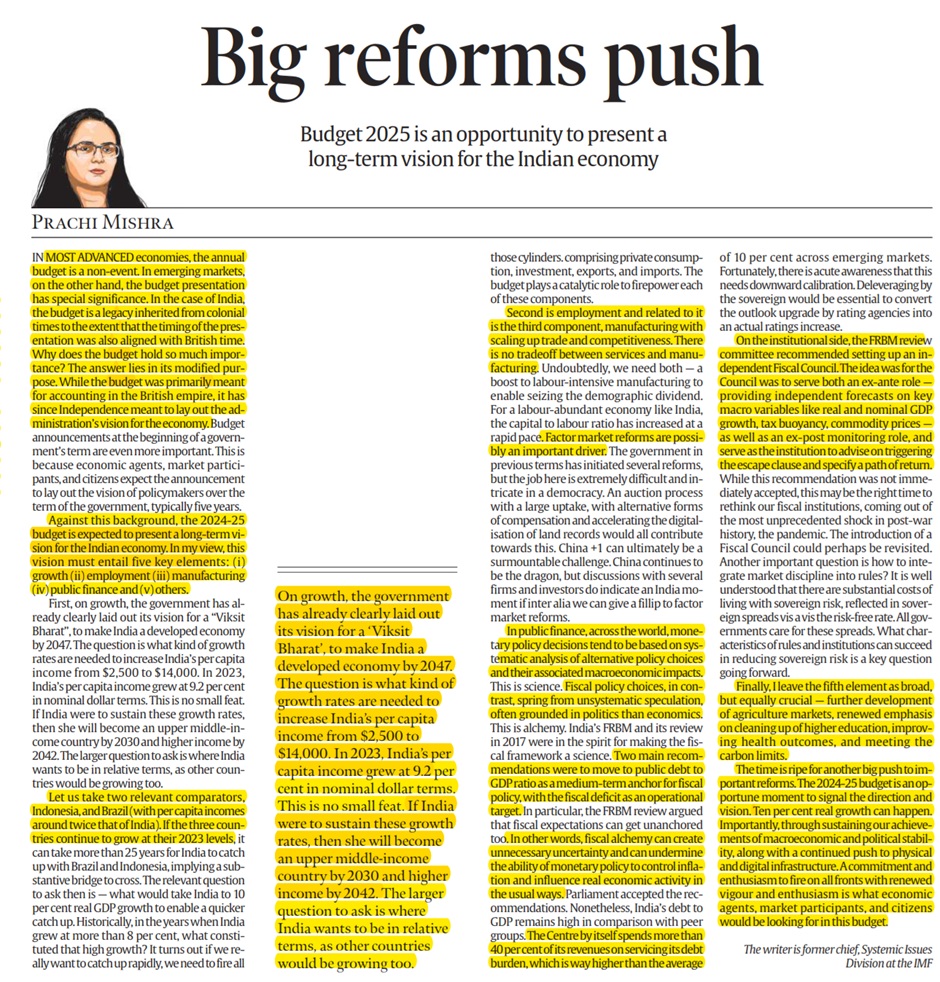
With new budget, chance for new vision for India
- In most advanced economies, the annual budget is a non-event.
- In emerging markets, on the other hand, the budget presentation has special significance.
- In the case of India, the budget is a legacy inherited from colonial times to the extent that the timing of the presentation was also aligned with British time.
- While the budget was primarily meant for accounting in the British empire, it has since Independence meant to lay out the administration’s vision for the economy.
Expectations
- The 2024-25 budget is expected to present a long-term vision for the Indian economy.
- In my view, this vision must entail five key elements: (i) growth (ii) employment (iii) manufacturing (iv) public finance and (v) others.
- The government has already clearly laid out its vision for a “Viksit Bharat”, to make India a developed economy by 2047.
- The question is what kind of growth rates are needed to increase India’s per capita income from $2,500 to $14,000.
- In 2023, India’s per capita income grew at 9.2 per cent in nominal dollar terms.
- If India were to sustain these growth rates, then it will become an upper middle-income country by 2030 and higher income by 2042.
- The relevant question to ask then is what would take India to 10 percent real GDP growth to enable a quicker catch up.
- It turns out if we really want to catch up rapidly, we need to fire all those cylinders. comprising private consumption, investment, exports, and imports. The budget plays a catalytic role to firepower each of these components.
- Second is employment and related to it is the third component, manufacturing with scaling up trade and competitiveness.
- There is no tradeoff between services and manufacturing.
- Undoubtedly, we need both — a boost to labor-intensive manufacturing to enable seizing the demographic dividend. For a labor-abundant economy like India, the capital to labor ratio has increased at a rapid pace.
- Factor market reforms are possibly an important driver. The government in previous terms has initiated several reforms, but the job here is extremely difficult and intricate in a democracy.
- In public finance, across the world, monetary policy decisions tend to be based on systematic analysis of alternative policy choices and their associated macroeconomic impacts.
FRBM
- On the institutional side, the FRBM review committee recommended setting up an independent Fiscal Council.
- The idea was for the Council was to serve both an ex-ante role providing independent forecasts on key macro variables like real and nominal GDP growth, tax buoyancy, commodity prices as well as an ex-post monitoring role, and serve as the institution to advise on triggering the escape clause and specify a path of return.
- The introduction of a Fiscal Council could perhaps be revisited. Another important question is how to integrate market discipline into rules
Conclusion
- Finally, I leave the fifth element as broad, but equally crucial: further development of agriculture markets, renewed emphasis on cleaning up of higher education, improving health outcomes, and meeting the carbon limits.
- The time is ripe for another big push to important reforms.
- The 2024-25 budget is an opportune moment to signal the direction and vision.
- A commitment and enthusiasm to fire on all fronts with renewed vigor and enthusiasm is what economic agents, market participants, and citizens would be looking for in this budget.